
Get free ice cream, celebrate Missouri milestones Aug. 10
Celebrate the 200th anniversary of Missouri’s statehood, as well as several local milestones, during a statewide ice cream social at Missouri S&T this August.
Read More »
Singler named interim chair of mathematics and statistics at S&T
Dr. John Singler has been named interim chair of Missouri S&T’s mathematics and statistics department. His appointment begins Wednesday, Sept. 1.
Read More »
Missouri S&T graduate named interim associate dean for research
Dr. David Borrok, chair of geosciences and geological and petroleum engineering (GGPE) at Missouri S&T, has been named interim associate dean for research in the College of Engineering and Computing (CEC) at S&T. The appointment became effective Aug. 1.
Read More »
Missouri S&T commencement speaker celebrates the beginning of post-college life
Commencement is not a celebration of the end of a college education, but a celebration of the beginning of life after college. That is the message John Warmack of Texarkana, Arkansas, told graduates of Missouri University of Science and Technology Saturday, July 31, during a special summer commencement ceremony. Warmack, principal at Warmack and Co. […]
Read More »Rainer Glaser elected fellow of American Chemical Society
The American Chemical Society (ACS) has elected Dr. Rainer Glaser, chair and professor of chemistry at Missouri S&T, as a fellow of its 2021 class.
Read More »
Missouri S&T researchers patent implants made with bioactive glasses and metals
Medical devices made of bioactive glasses and metals that dissolve at the end of their operational lifespan could replace other types of implants and eliminate the need for invasive removal once they have served their purpose, say researchers at Missouri S&T. The researchers recently received a patent for the device.
Read More »
Missouri S&T offers summer research for students from HBCUs
Eight students from historically Black colleges and universities (HBCUs) participated in a summer program at Missouri S&T that is designed to encourage engineering students from underrepresented groups to pursue graduate studies. This year, students in Missouri S&T’s Summer Engineering Research Academy (SERA) visited Rolla from Oakwood University in Huntsville, Alabama, Tennessee State University in Nashville and Morgan State University in Baltimore.
Read More »
Missouri S&T to require face coverings effective Monday, Aug. 2
Missouri University of Science and Technology will require face coverings in certain indoor areas on campus beginning Monday, Aug. 2. The new policy, announced today (Thursday, July 29), requires all students, faculty, staff and visitors to wear face coverings in classrooms and laboratories beginning Monday. This policy applies to all, regardless of vaccination status. Face […]
Read More »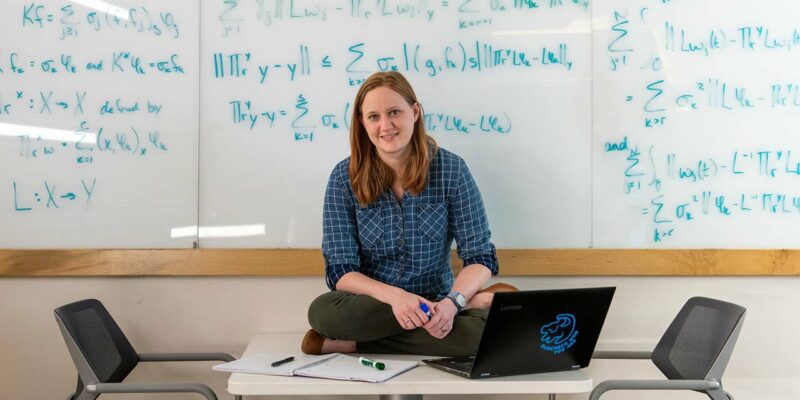
A formula for success
Sarah Locke grew up in the small rural town of Lynnville, Tenn., before earning her bachelor’s degree in mathematics from the University of Tennessee at Martin in 2016. “I grew up on a cattle farm and loved every minute of it,” says Locke, who is currently pursuing a doctoral degree in mathematics at Missouri S&T. Locke […]
Read More »
S&T adds medical lab science certification as a biological sciences emphasis area
A new program at Missouri S&T will allow those interested in the field of medical laboratory science to study in the Missouri S&T biological sciences department for three years and then finish their degree with a year of clinical professional study at one of three certified Missouri hospital programs.
Read More » Sports Headlines
- Edmonds and Fraser Earn GLVC Scholar-Athlete Honors
- Miners Set School Record with 48 Council of Presidents’ Academic Honors
- S&T Sets New Department Standard for Br. James Gaffney Distinguished Scholar Honorees
- Missouri S&T Shatters School Record with 381 GLVC All-Academic Honorees
- Twelve Miners Earn CSC Academic All-District Honors for Track & Field/Cross Country