Science & Tech

Missouri S&T joins LIGO and Virgo’s newest research on neutron star smash-ups
This spring semester, Missouri S&T became the state’s only institution to join the worldwide LIGO (Laser Interferometer Gravitational-wave Observatory) Scientific Collaboration (LSC) of researchers committed to detecting cosmic gravitational waves. This research explores the fundamental physics of gravity using the emerging field of gravitational wave science as a tool for astronomical discovery.
Read More »

Missouri S&T grad helps capture first-ever image of a black hole
For the first time ever, scientists have captured an image of a black hole, and a Missouri S&T graduate played an important role. Dr. Frederick K. Baganoff, a research scientist at the Massachusetts Institute of Technology’s Kavli Institute for Astrophysics and Space Research, is among the collaborators on the international Event Horizon Telescope project to produce the first direct images of a black hole. Baganoff earned a bachelor of science degree in physics from Missouri S&T in 1985.
Read More »
Researchers discover an economical way to produce high-performance thin films for electronics
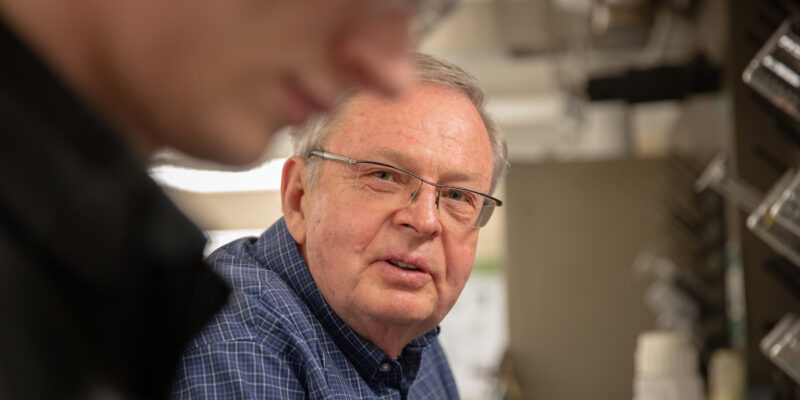
Researchers at Missouri S&T have found an unprecedented, economical method for creating high-performance inorganic thin films, or “epitaxial” films, used in the manufacture of semiconductors for flexible electronics, LEDs and solar cells.
Read More »Physics researchers discover new approach to control the spread of light
Physics researchers have discovered a new way to control light — one that produces a concentrated, optically energetic laser beam when transmitted through diffuse media such as fog, biological tissue or white paint — rather than the typical weaker light with a lateral spread.
Read More »

Plant detective: Missouri S&T professor studies plants as “bio-sentinels” of indoor pollution
Behold the common house plant, the front-yard shrub, the rhododendron around back that’s seen better days since the next-door neighbors put their home on the market. They brighten our lawns, increase our property values, even boost our mental and physical health by reducing carbon dioxide levels.
For Dr. Joel Burken, such plants are far more valuable than as mere window dressing. The Curators’ Distinguished Professor and chair of civil, architectural and environmental engineering at Missouri University of Science and Technology is an expert in phytoforensics, the process of using plants to study human exposure to pollutants.

FYRE program advances freshman’s STEM passion
Kaysi Lee came to Missouri S&T last fall with a passion for science that had been nurtured through the years by her female high school science teachers and by her parents. But when she arrived at S&T, she was surprised at how difficult she initially found her STEM coursework.
Read More »
Chemistry undergraduate completes summer fellowship with gratitude and a published, peer-reviewed paper
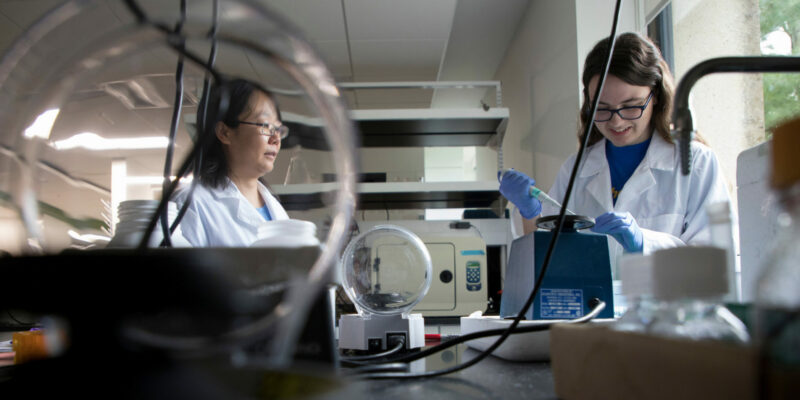
Rachel Nixon, a junior in chemistry at Missouri S&T and recipient of the new Carey and Christine Bottom Endowed Scholarship in Undergraduate Chemistry Research, is thankful for the 10-week program she completed this summer. Working in Dr. Risheng Wang’s bionanotechnology lab eight hours a day, Nixon finished her peer-reviewed, published paper for a DNA-origami project already underway, then began a new project.
Read More »

Missouri S&T chemist rolls the dice to better identify chiral molecules in drugs
“High risk, high reward” is the kind of discovery Dr. Garry Grubbs seeks with a new experiment designed to rapidly identify the atomic structure of chiral molecules widely used in pharmaceutical drugs. The finding could significantly reduce the time and costs involved in pharmaceutical development and manufacturing.
Read More »

Ozark Biomedical Initiative Research Symposium to be held Aug. 18
Researchers from Missouri S&T and Phelps County Regional Medical Center (PCRMC) will present their research at an annual symposium hosted by the Ozark Biomedical Initiative (OBI) on Saturday, Aug. 18.
Read More » Sports Headlines
- Baseball Completes Sweep of UIS with Pair of Walk Off Wins in Extras; Win Streak Increases to 19
- Miners Sweep Lewis Behind LaChappell’s Two-Triple, Four-RBI Game
- Baseball Sweeps UIS in Saturday DH to Claim Top Spot in GLVC
- Volleyball Downs the Hawks in Four, Extends Win Streak to Nine
- Softball Drops Pair of One-Run Games at No. 7 UIndy; Miller Hits 200 Career Strikeouts