Research
Missouri S&T named to National Academy of Inventors
Missouri University of Science and Technology has been named a charter member of the National Academy of Inventors, an organization that promotes research and innovation among research universities.
Read More »

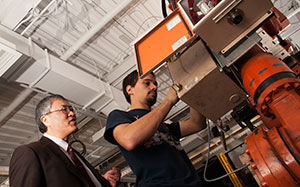
S&T professor develops ‘brain’ for robots
A researcher at Missouri University of Science and Technology has developed a new feedback system to remotely control mobile robots. This innovative research will allow robots to operate with minimal supervision and could eventually lead to a robot that can learn or even become autonomous.
Read More »Innovative concrete bridge to open this fall near Jefferson City, Mo.
Just east of Jefferson City, Mo., sits a construction site that will soon be home to one of the nation’s first bridges to incorporate an unusual concrete mix in its girders and support structure. The three-span bridge, which is scheduled to be completed this fall on Highway 50, will also be outfitted with various sensors […]
Read More »
Researchers study ways to make stronger materials in 3-D
Aided by funding from NASA and using methods similar to 3-D printing, researchers at Missouri University of Science and Technology are running computer simulations of processes that could lead to stronger, more durable materials for the space agency.
Read More »

S&T researchers create model for managing urban restoration after a natural disaster
Helping a community recover quickly after a major disaster is the goal of a new project by researchers at Missouri University of Science and Technology.
Read More »

New book examines life of first female Egyptologist
Margaret Alice Murray, one of the first women to practice archaeology and the first woman to publicly unwrap a mummy, is the subject of a new book by Missouri University of Science and Technology historian Dr. Kathleen Sheppard.
Read More »

Buy or sell? Response may depend on how investment news is delivered
Some investment firms are looking at using online videos to bring financial news to their investors. But researchers at Missouri University of Science and Technology caution firms to first consider the nature of the news before deciding how to distribute it.
Read More »IT helps researchers see their data like never before
Making sense of the ever-increasing mounds of data is one of the great challenges facing researchers today. At Missouri University of Science and Technology, staff and students in the information technology department have come up with an approach to help researchers gain a new perspective on their data.
Read More »Researchers get NASA funding to study how to propel and control tiny spacecraft
NASA hopes to expand scientific understanding of the Earth and the universe, but current small satellites that gather vital information can’t be controlled once they’ve been released into space. Two researchers at Missouri University of Science and Technology think they may have discovered a fix for the problem.
Read More »Glass scaffolds that help heal bone show promise as weight-bearing implants
Researchers at Missouri University of Science and Technology have developed a type of glass implant that could one day be used to repair injured bones in the arms, legs and other areas of the body that are most subject to the stresses of weight.
Read More » Sports Headlines
- 2026 Miner Athletic Hall of Fame Induction Class Announced
- S&T Men's Basketball Earns Team Academic Excellence Awards; Five Miners Named to Honors Court
- S&T Men's Volleyball Earn AVCA Team Academic Award
- Ten Miners and Both Teams Earn USTFCCCA All-Academic; Fraser Named Scholar Athlete of the Year
- S&T Welcomes Ryan Hunt as New Assistant Track & Field Coach