Research
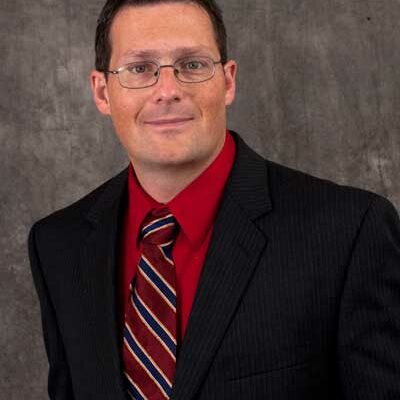
S&T chemist earns DOE early career award
Dr. Richard Dawes, an assistant professor of chemistry at Missouri University of Science and Technology, has been selected to receive an Early Career Award from the U.S. Department of Energy through the Office of Basic Energy Science.
Read More »
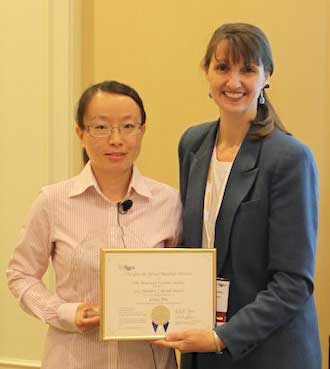
S&T grad student honored for glass research
Missouri University of Science and Technology graduate student Lina Ma has received national recognition for her research on the structure and properties of iron phosphate glasses. These glasses can possess outstanding chemical durability and so have been considered for use to store radioactive wastes.
Read More »
S&T researcher develops technique to detect breast cancer in urine
A Missouri University of Science and Technology researcher has developed a new screening method that uses urinalysis to diagnose breast cancer – and determine its severity – before it could be detected with a mammogram. A study to confirm this technique’s effectiveness is under way at Mercy Breast Center in Springfield, Mo.
Read More »S&T professor’s ‘multicopter’ improves structure monitoring
The current method of inspecting bridges for structural damage is labor-intensive and, in some instances, dangerous to all involved. Dr. Zhaozheng Yin, assistant professor of computer science at Missouri University of Science and Technology, and his engineering team have been developing a safer, more efficient solution with his latest research project, the “multicopter.”
Read More »
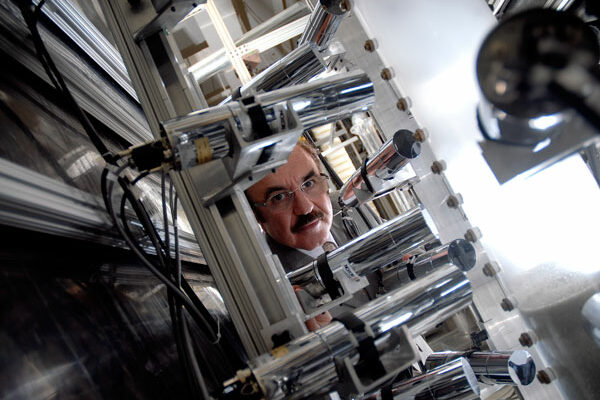
Researcher studies fuel flow patterns for next-generation reactors
At Missouri University of Science and Technology, where the state’s first nuclear reactor was constructed more than 50 years ago, researchers are tracking and measuring the movement of radioisotopes to develop sophisticated new standards for the next generation of reactors.
Read More »S&T’s Solar Village to house microgrid project
Four solar homes built by students at Missouri University of Science and Technology will soon become home to an experimental microgrid to manage and store renewable energy. The houses, all past entries into the Solar Decathlon design competition, make up the university’s Solar Village.
Read More »Professor to guide three students’ Brazil research
At Missouri University of Science and Technology, the idea of a student missing the annual St. Pat’s celebration is pretty rare. Missing that and spring break is unheard-of. But that is exactly what Dr. Daniel Oerther and three of his students are going to do. The group will spend the latter half of March conducting research and field work in Para, Brazil.
Read More »‘Helpful technology’ vs. Big Brother examined by S&T researchers
Collecting and analyzing data about how students use the Internet could lead to advances in mental health. But some worry that using technology in this manner could erode privacy.
Read More »S&T research predicts growth, survival of ‘superorganism’ ant colonies
 Smaller ant colonies tend to live faster, die younger and burn up more energy than their larger counterparts, as do the individual ants that make up those colonies, according to new research that views the colonies as “superorganisms” in which social insects function much like the cells of a body.
