Science & Tech
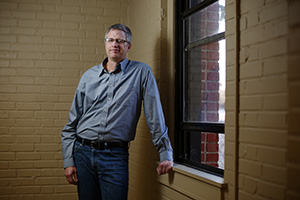
S&T researcher to study how window opening affects indoor air quality
When it’s snowing, raining or extremely hot, you may not expect many people to open windows in their homes. But, Dr. Glenn Morrison, professor of environmental engineering at Missouri University of Science and Technology, says that lots of people have windows open even in extreme weather.
Read More »

S&T researcher finds hydrogen production in extreme bacterium
A researcher at Missouri University of Science and Technology has discovered a bacterium that can produce hydrogen, an element that one day could lessen the world’s dependence on oil.
Read More »

McMillin named associate dean
Dr. Bruce McMillin, professor of computer science and interim associate dean of the College of Engineering and Computing at Missouri University of Science and Technology, was named associate dean for research and external relations in Missouri S&T’s College of Engineering and Computing effective Jan. 1.
Read More »

New book edited by S&T researcher covers ultra-high-temperature materials
Ultra-high-temperature ceramics that melt at temperatures above 3,000 degrees Celsius are the focus of a new collection of research findings co-edited by Dr. William Fahrenholtz, Curators’ Professor of ceramic engineering at Missouri University of Science and Technology. It is the first book in over 20 years to concentrate on these ceramic materials.
Read More »

14 important research stories of 2014
Nanowire growth, smart rocks, nuclear fusion and a new view of D-Day. These were among the most notable advances in research made by Missouri University of Science and Technology professors and their students in 2014. Here are 14 that were publicized during the year, but are well worth talking about again.
Read More »

Missouri S&T researcher grows uniform nanowires
A researcher from Missouri University of Science and Technology has developed a new way to grow nanowire arrays with a determined diameter, length and uniform consistency. This approach to growing nanomaterials will improve the efficiency of various devices including solar cells and fuel cells.
Read More »

How engineering could help you survive a zombie apocalypse
Not every university prepares budding engineers and managers to survive a zombie apocalypse while teaching them how to manage global supply chains or large-scale industrial operations.
Read More »

Social networks can strengthen knowledge-sharing
Contrary to the notion that social networks are time-wasters, they could improve project management and the spread of specialized knowledge in the healthcare sector and possibly other large organizations, according to new research from Missouri University of Science and Technology.
Read More »

S&T receives $3 million from NSF to train cybersecurity experts
Researchers at Missouri University of Science and Technology are working to combat threats to cybersecurity by training the next generation of experts in the field. With a $3 million grant from the National Science Foundation, Missouri S&T’s computer science department will fund approximately 16 “Scholarship for Service” master of science and Ph.D. students, who will specialize in cybersecurity.
Read More »
Missouri S&T professor works to separate mixed gases
Current methods of separating mixed gases are energy-intensive, costly and inefficient. A chemical engineering professor at Missouri University of Science and Technology is developing a new, energy-efficient adsorbent that will improve common gas separation processes.
Read More » Sports Headlines
- Miners Extend Win Streak to Five with Doubleheader Victory Over Truman
- Miners Open Outdoor Season Strong at Miner Invitational
- Nelson’s Three-Homer Game Powers Miners to Split at UMSL
- Miners Hit Program Record .667 in Dominant Victory on Senior Day
- Meyer Becomes First Miner in 1000 Kills Club; Miners Sweep Jimmies