College of Engineering and Computing
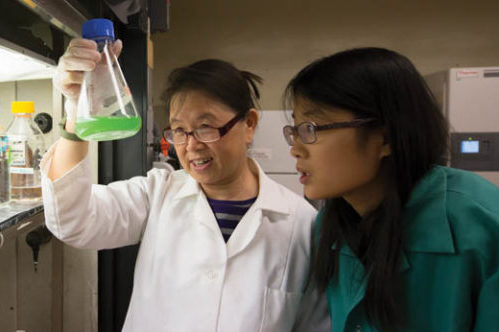
Missouri S&T, PCRMC partner on new research
Researchers from Missouri University of Science and Technology are working with physicians and clinicians from Phelps County Regional Medical Center on medical research that could lead to new treatments for cancer and traumatic brain injury, a new way to predict potential problems at childbirth, and a method to attract and capture poisonous brown recluse spiders.
Read More »S&T announces Undergraduate Research Conference winners
The winners of the 13th annual Undergraduate Research Conference at Missouri University of Science and Technology have been announced. The conference, which was held in April on the S&T campus, featured oral and poster exhibitions that represented work from students in nearly every major at Missouri S&T. Winners were awarded a cash prize of $750. Second- and third-place finishers received $500 and $250, respectively.
Read More »Missouri S&T students receive Grainger Power Engineering Awards
Thirteen electrical engineering seniors and recent graduates will each receive a $6,000 Grainger Power Engineering Award from the electrical and computer engineering department at Missouri University of Science and Technology. The awards are presented as a reward for academic excellence.
Read More »Going places
From the deserts of Utah to the moons of Jupiter, Katelyn Brinker advances the future of space exploration When the European Space Agency launches its mission to explore Jupiter’s moons in 2022, the ambitious effort will stay connected to Earth thanks in part to the work of Missouri S&T student Katelyn Brinker.
Read More »Geotechnical engineering expert to present first Prakash Lecture at S&T
Dr. Richard D. Woods, a member of the National Academy of Engineering and a professor emeritus of civil and environmental engineering at the University of Michigan-Ann Arbor, will present the inaugural lecture in the Shamsher and Sally Prakash Distinguished Lecture Series in Geotechnical Engineering.
The lecture, titled “Geotechnical Impact of High Energy Construction Operations on Nearby Infrastructure,” will be held at 8:45 a.m. Thursday, May 18, in Room 125 Butler-Carlton Hall. It is free and open to the public.
Read More »Missouri S&T Concrete Conference canceled, reset for June 6-7
Due to major road closures leading into and out of Rolla as well as statewide flooding, Missouri University of Science and Technology has canceled the 2017 Concrete Conference, originally scheduled for May 2-3 on the Missouri S&T campus. The conference has been rescheduled for Tuesday, June 6, and Wednesday, June 7. Current participants will remain registered and expected for the June dates. An updated schedule of events will be available at concrete.mst.edu.
Read More »Former deputy director of national intelligence to speak at Missouri S&T commencement
Stephanie O’Sullivan, former principal deputy director of National Intelligence at the Office of the Director of National Intelligence, will speak at two commencement ceremonies at Missouri S&T this month. O’Sullivan is a 1982 civil engineering graduate of Missouri S&T. During commencement, O’Sullivan will receive the doctor of science, honoris causa.
Read More »National experts come to S&T for GeoMO 2017
Civil and environmental experts are the featured speakers when Missouri University of Science and Technology hosts the 2017 GeoMo symposium May 18.
The symposium, titled “Geophysics and Nondestructive Evaluation in the Assessment and Monitoring of Geotechnical and Infrastructure Systems,” is from 8 a.m. to 5 p.m. on Thursday, May 18 in Room 125 Butler-Carlton Civil Engineering Hall on the Missouri S&T campus.
Read More »Lead acid batteries to store energy in S&T’s EcoVillage
By Halloween, Missouri University of Science and Technology’s new EcoVillage microgrid will be up and running on solar panels and storing excess energy with lead acid batteries.
In conjunction with the Advanced Lead Acid Battery Consortium (ALABC), Missouri S&T’s Microgrid Industrial Consortium partners Doe Run, Ameren and Azimuth Energy are designing the EcoVillage microgrid. Missouri S&T researchers Dr. Mehdi Ferdowsi, professor of electrical and computer engineering; Dr. Pourya Shamsi, assistant professor of electrical and computer engineering; and Dr. Fatih Dogan, professor of materials science and engineering, also are working on the design.
Read More »S&T senior honored with IEEE award
Katelyn Brinker has her head in the clouds — or, actually, way beyond them. Like Mars and Jupiter and beyond.
A member of Missouri University of Science and Technology’s Mars Rover Design Team, Brinker was named an IEEE-USA New Faces of Engineering, College Edition, honoree.
Read More » Sports Headlines
- Wells and Bradley Jr. Set to Represent S&T at Annual GLVC Football Kickoff Tomorrow
- S&T's Owen Fraser Named Academic All-America of the Year for NCAA Division II
- Missouri S&T Athletics Partners with vivenu for New Digital Ticketing Platform
- 2026 Miner Athletic Hall of Fame Induction Class Announced
- S&T Men's Basketball Earns Team Academic Excellence Awards; Five Miners Named to Honors Court