Engineers Week Q&A: Maryam Osali aims to transform waste into opportunity
Posted by Greg Edwards
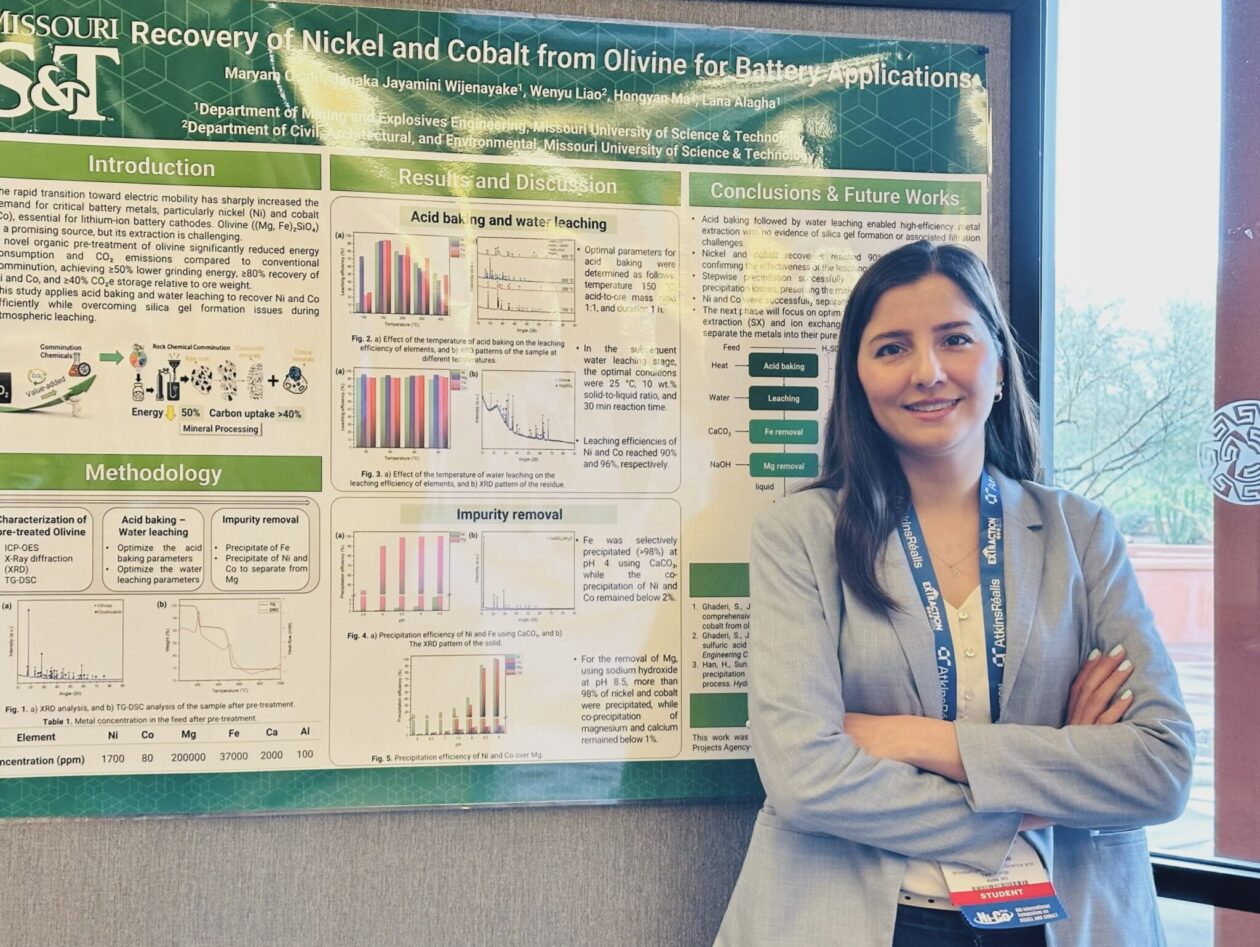
Maryam Osali stands with the research poster she presented at the Extraction 2025 Meeting & Exhibition in Phoenix. Photo courtesy of Osali
Maryam Osali is a Ph.D. student in mining engineering at Missouri S&T. Here is a Q&A with Osali in commemoration of National Engineers Week 2026.
In basic terms, how would you describe what you research as a Ph.D. student in mining engineering, and why is it important?
I work on recovering critical minerals like nickel and cobalt from mine tailings materials that were previously considered waste. These metals are essential for battery production, and right now the U.S. depends heavily on foreign imports for them. Instead of only looking for new mines, my research focuses on turning existing mining waste into a valuable domestic resource. What makes this important is that we are solving two problems at the same time: reducing environmental waste from tailings and recovering strategic minerals needed for clean energy technologies. In a way, we are redefining waste as opportunity.
Before coming to Missouri S&T, you studied metallurgical engineering in Iran. What inspired you to transition into mining and mineral engineering?
My academic background has always been in extractive metallurgy. So, in many ways, I did not truly change my field, as I continue to focus on extraction. Mining and extractive metallurgy are closely connected disciplines, and this opportunity allowed me to apply my metallurgical expertise within a broader mining context. Being in the mining and explosives engineering department has expanded my perspective to include sustainability, waste management and the domestic supply of critical minerals.
What aspects of your discipline do you find most fascinating?
What fascinates me most is the idea that we can extract tiny amounts of critical elements like nickel and cobalt and turn them into materials that power high-tech systems. Without nickel and cobalt, modern batteries would not exist, and without batteries, much of our daily technology and clean energy transition would not be possible. It’s exciting to know that something recovered from what was once considered waste can eventually become part of an advanced battery. I also enjoy being part of a research group that works across the entire value chain, from mineral processing and extractive metallurgy to battery material production, where I can see the results of my work move from tailings to a functional battery material.
What do you hope to do after finishing your Ph.D. program at Missouri S&T?
After completing my Ph.D., I hope to continue my career in academia, ideally starting as a postdoctoral researcher. Working in a university environment allows me to stay at the forefront of new technologies and continuously engage with innovation. I would like to lead research projects and mentor students, helping them approach problems systematically and think critically. At the same time, I am interested in collaborating closely with industry research and development sectors to translate research findings into practical, scalable processes. For me, academia is not only about publishing papers but also about building research teams that connect fundamental science with real industrial challenges.
What advice would you give students who are interested in mining or metallurgical engineering?
Honestly, when I chose this major at 18, I didn’t fully understand what it was. Many people even asked me if it was just chemistry. But it’s much broader than that; it combines chemistry, thermodynamics, kinetics, materials science and engineering principles. If you enjoy working in the lab and solving real problems, this field can be incredibly rewarding. It’s not just sitting behind a computer all day; you are experimenting, testing, analyzing and physically seeing the transformation of materials. Mining and metallurgical engineering are directly connected to clean energy, battery technology and modern infrastructure, offering meaningful opportunities to contribute to society.


Leave a Reply