Missouri S&T researcher combines lessons from ants and birds to improve AI
Posted by Greg Edwards
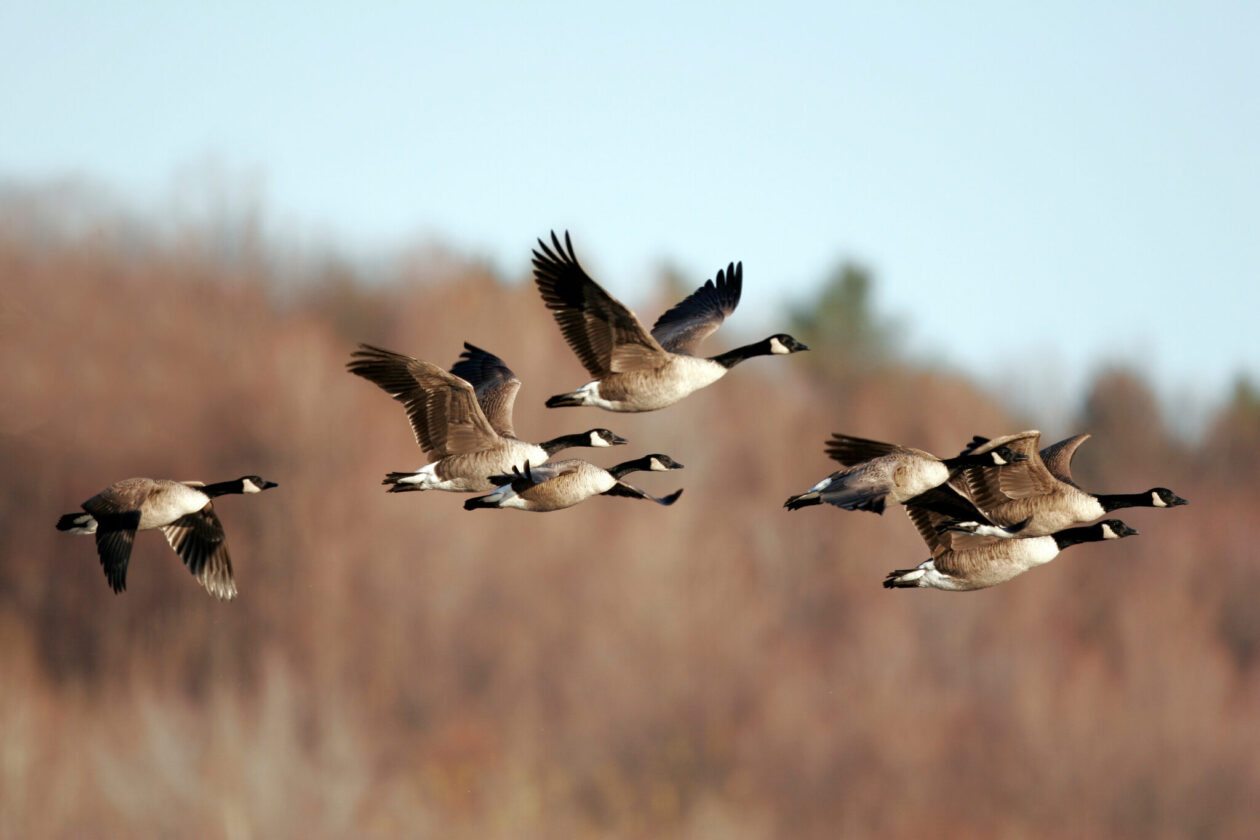
A flock of Canada geese flies in formation. Photo courtesy of Adobe Stock.
Combining ideas inspired by ant colonies and flocks of birds may hold the key to unlocking more effective artificial intelligence, according to a researcher at Missouri S&T.
“With the way AI algorithms are currently structured, they sometimes settle on an answer that seems good enough and stop searching before finding one that may be much better,” says Dr. Donald Wunsch, director of Missouri S&T’s Kummer Institute Center for AI and Autonomous Systems. “It’s important that we find ways to help these algorithms keep searching instead of stopping too soon. When AI is used in areas that affect people’s health, safety or cost of living, the difference between good enough and great can have significant implications.”
Wunsch, who is also S&T’s Mary K. Finley Missouri Distinguished Professor of electrical and computer engineering, said this challenge led him and Dr. Ashraf M. Abdelbar of Brandon University in Canada to combine two established nature-inspired computing techniques in hopes of creating an algorithm that could help overcome the issue.
One of the approaches, known as ant colony optimization, is inspired by the way ants collectively find the most efficient routes to food. The other, called particle swarm optimization, draws inspiration from the way birds and other groups share information and adjust their behavior based on successful neighbors.
“Each approach has its own strengths,” Wunsch says. “Our idea was to combine them in a way that encourages the search to continue exploring promising alternatives.”
Wunsch and Abdelbar published their findings in the journal Memetic Computing.
Compared to the standard ant colony optimization algorithm, the researchers’ combined approach performed better in 48 of 65 tests involving neural networks — a type of AI model that learns to identify patterns in data — and 47 of 63 complex mathematical optimization tests with up to 30,000 variables.
“Even when working on highly complex computational problems, inspiration can sometimes come from simply observing nature,” Wunsch says. “We’re encouraged by the results so far and look forward to continuing this research as AI systems take on increasingly complex and important tasks.”
To learn more about Missouri S&T’s electrical and computer engineering programs, visit ece.mst.edu.
About Missouri S&T
Missouri University of Science and Technology (Missouri S&T) is a STEM-focused research university of over 7,000 students located in Rolla, Missouri. Part of the four-campus University of Missouri System, Missouri S&T offers over 100 degrees in 40 areas of study and is among the nation’s top public universities for salary impact, according to the Wall Street Journal. For more information about Missouri S&T, visit www.mst.edu.

Posted by Greg Edwards
 Sports Headlines
- 2026 Miner Athletic Hall of Fame Induction Class Announced
- S&T Men's Basketball Earns Team Academic Excellence Awards; Five Miners Named to Honors Court
- S&T Men's Volleyball Earn AVCA Team Academic Award
- Ten Miners and Both Teams Earn USTFCCCA All-Academic; Fraser Named Scholar Athlete of the Year
- S&T Welcomes Ryan Hunt as New Assistant Track & Field Coach
Leave a Reply