Research

Researchers use glass to limit spread of drug-resistant bacteria
As G20 health experts meet this week to discuss the need for new antibiotics to combat drug-resistant bacteria, researchers at Missouri University of Science and Technology are looking to an unusual material – glass – to limit the spread of drug-resistant bugs in humans.
Read More »Learning for life
Missouri S&T doctoral student Ken Boyko isn’t exactly slowing down during his”retirement.”
At 65, Boyko is preparing to complete a Ph.D. in geological engineering, perhaps as soon as this fall. His research focuses on how LIDAR (light detection and ranging) scanners can be used to “see through” vegetation that might otherwise prevent detection of potential falling rock. The research could enhance safety along highways and bridges and also involved a project for the U.S. Navy, which wants to use the technology as a navigational aid for self-driving off-road vehicles.
Read More »S&T researcher studies next generation phones, cars
In 10 years, your cellphone won’t look anything like it does today — at least on the inside. The phones, with 5G technology, will be 10 times faster than they are today. And self-driving cars won’t be a novelty, they will be part of your daily commute.
A Missouri University of Science and Technology researcher is working to make those goals a reality — a safe reality — by deciphering and solving the problems of electromagnetic interference inherent in the systems. Dr. Jun Fan, professor of electrical and computer engineering at Missouri S&T, is using a Google grant to provide real-world solutions.
Read More »With Scholars’ Mine, over 1 million served globally
Somewhere on the lower west side of Chicago, an internet user seeking information about photografting – a technique for attaching polymers to surfaces – recently struck gold with a visit to Scholars’ Mine, Missouri University of Science and Technology’s online repository of research papers, creative works and other documents.
Read More »
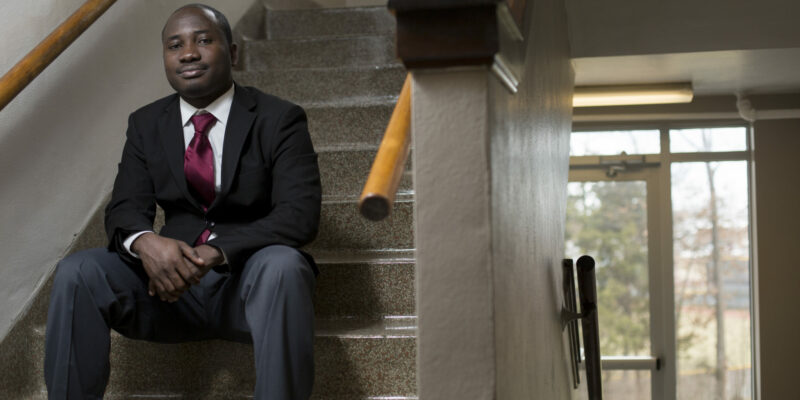
Learn locally, act globally
As a doctoral student in mining engineering, Kenneth Bansah works, learns and lives nearly 10,000 miles from his boyhood home of Tarkwa, Ghana, a gold mining hub in western Africa. But even as he fine-tunes his dissertation on mitigating sinkhole hazards and other karst formations − and takes care of three children ages four and under while his wife completes her own graduate studies in Michigan – the subsistence gold miners of Ghana are never far from Bansah’s mind.
Read More »

Missouri S&T research team helps Boeing set up nondestructive evaluation laboratory
Researchers at Missouri University of Science and Technology recently worked with The Boeing Company to establish a new nondestructive evaluation laboratory that uses millimeter wave technology to improve the detection of potential flaws in coatings, surfaces and materials.
Read More »

Missouri S&T researcher works to develop nanodiamond materials
When you think of diamonds, rings and anniversaries generally come to mind. But one day, the first thing that will come to mind may be bone surgery. By carefully designing modified diamonds at the nano-scale level, a Missouri University of Science and Technology researcher hopes to create multifunctional diamond-based materials for applications ranging from advanced composites to drug delivery platforms and biomedical imaging agents.
Read More »
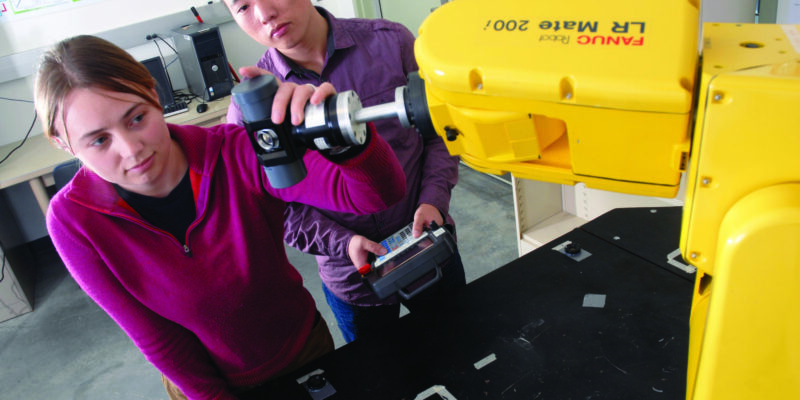
Researchers develop ways to improve machining, milling processes
Fixing flaws introduced during the machining of large components used in the aircraft and heavy equipment industries can be time-consuming for manufacturers – and costly if they must scrap the flawed parts after they’ve been fabricated. A new approach developed by researchers at Missouri University of Science and Technology is helping manufacturers eliminate those flaws […]
Read More »
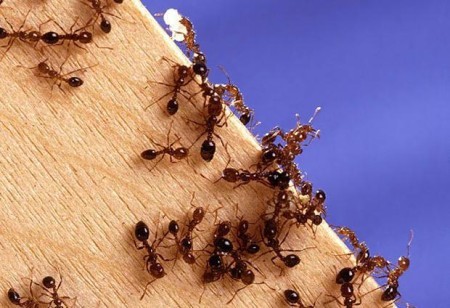
S&T researchers suggest ants need work-life balance to survive
As humans, we constantly strive for a good work-life balance. New findings by researchers at Missouri S&T suggest that ants, long perceived as the workaholics of the insect world, do the same. In fact, according to these researchers, it is imperative that some ants rest while others work to conserve food, energy and resources for […]
Read More »

Additive manufacturing: A new twist for stretchable electronics?
Electronic components that can be elongated or twisted – known as “stretchable” electronics – could soon be used to power electronic gadgets, the onboard systems of vehicles, medical devices and other products. And a 3-D printing-like approach to manufacturing may help make stretchable electronics more prevalent, say researchers at Missouri University of Science and Technology.
Read More » Sports Headlines
- Baseball Adjusts Series Schedule vs Quincy; Ring Ceremony Set for Saturday
- Golf Changes Schedule, Will Head to SVSU Spring Invitational in Kentucky
- Miners Hosting Rockhurst for First Home GLVC Contests
- Missouri S&T Ready for NCAA Division II Indoor Championships in Virginia Beach
- Miners Head to Branson to Face Minnesota Duluth Before Opening GLVC Play at Drury