S&T researchers contribute to cosmic dataset now available to the public
Posted by Peter Ehrhard
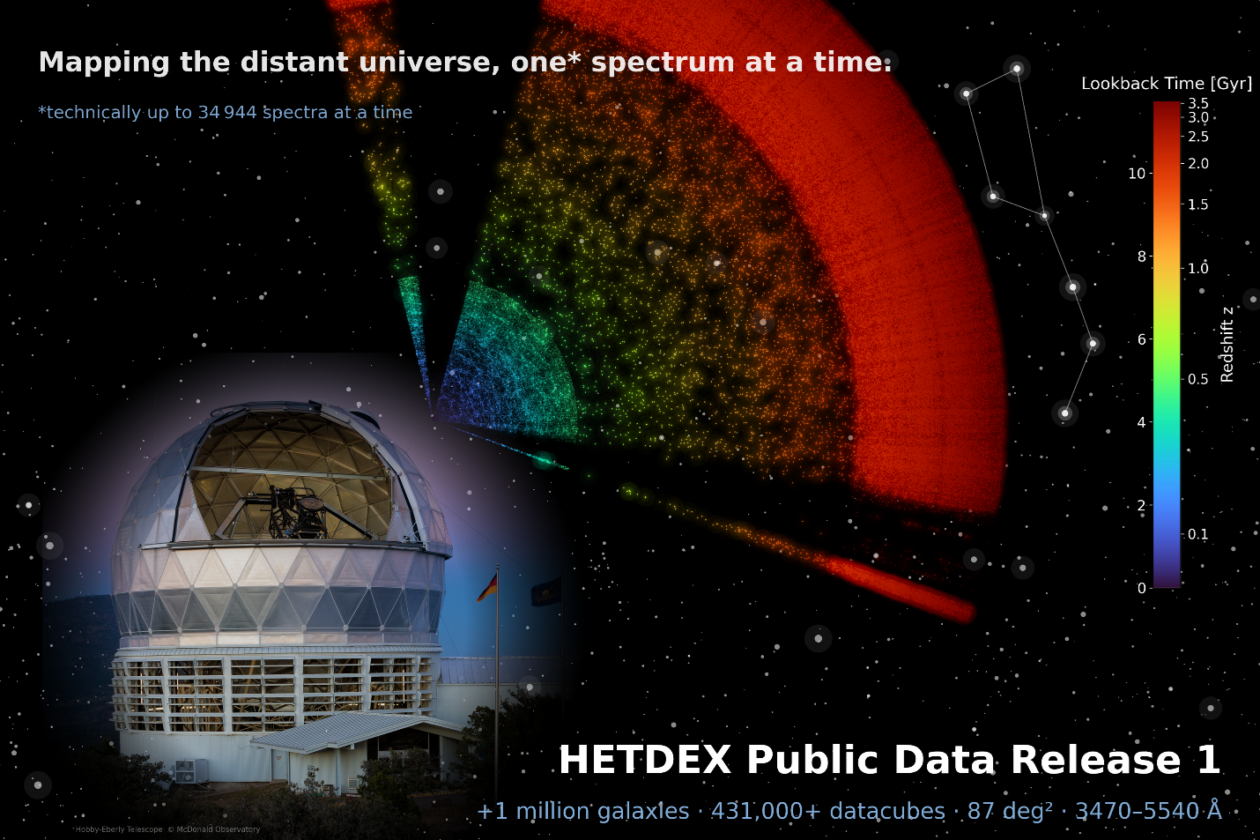
From 2017 to 2024, the Hobby-Eberly Telescope at McDonald Observatory surveyed a region of night sky equivalent to 2,000 full Moons, creating a map of galaxies in the distant universe. A portion of that map, corresponding to a region of the sky in the direction of the Big Dipper, is shown here. Image credit: E. Mentuch Cooper, S. Mukae, HETDEX.
On Wednesday, June 3, researchers affiliated with the Hobby-Eberly Telescope Dark Energy Experiment (HETDEX), released all of its database to the public. Built from more than half a petabyte of raw and processed data, it will allow astronomers to study how the first galaxies formed and evolved, measure how gas and stars were distributed within these galaxies, and map the large-scale structure of the cosmos.
Today’s release marks the first time the full HETDEX dataset and survey catalog have been made available together. While the core survey is now complete, observations are ongoing, calibrations continue to improve, and supplementary releases are expected for the future.
Scientists, students, and citizen researchers can download customized subsets of data based on sky location. Or they can perform large-scale analysis using high-performance, cloud-based supercomputing resources through the University of Texas-Austin’s Texas Advanced Computing Center.
Dr. Shun Saito, chair of the HETDEX Cosmology Science Working Group and an associate professor of physics at Missouri University of Science and Technology, was one of the contributing researchers to the database. Along with Saito, Missouri S&T researchers Hasti Khoraminezhad, a postdoctoral fellow in physics, and Deeshani Mitra, a Ph.D. student in physics, also contributed to the work.
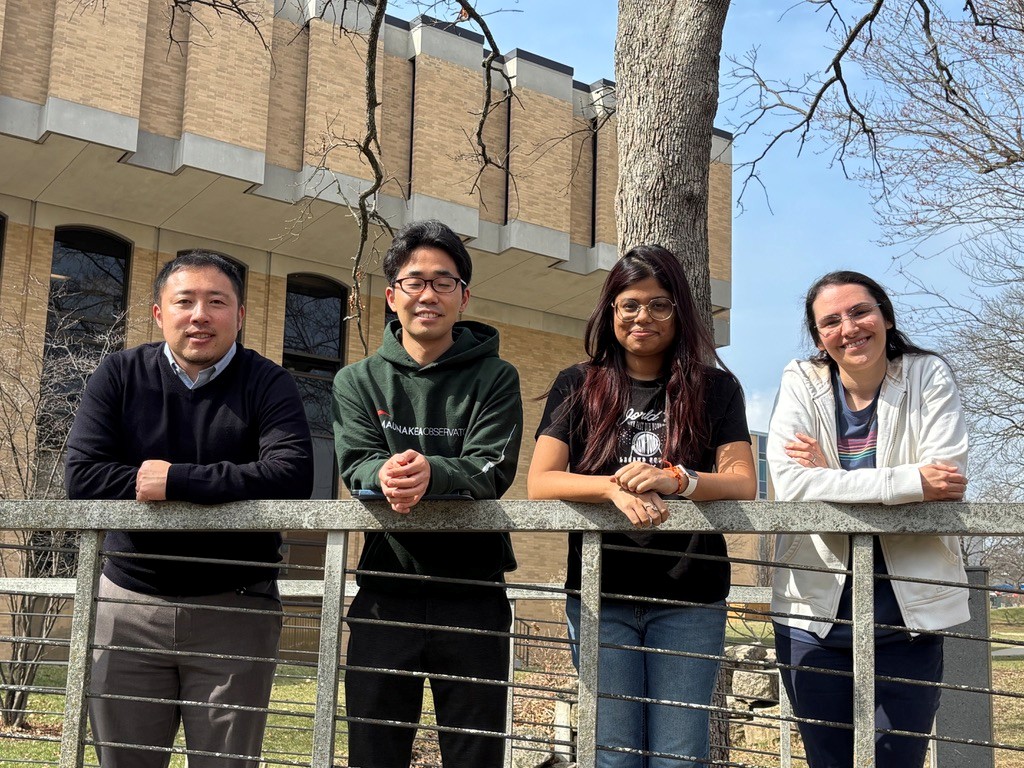
“I am proud of our contribution to the data analysis to help create the robust and unique map of bright galaxies. Our group at Missouri S&T is the only official institution in Midwest among 11 international member institutions,” says Saito. “Hasti and Deeshani not only helped the data analysis for the project but also are leading exciting cosmology and galaxy formation science which will come soon.”
In addition to raw data, the release also contains a catalog of every object HETDEX has found so far: over one million distant galaxies, half a million nearby star-forming galaxies, 18,000 supermassive blackholes, and over 150,000 stars.
“This is a spectral map of the universe. It turns every point of light into a barcode of physics,” said Erin Mentuch Cooper, HETDEX data manager and lead author on the paper announcing the release. “The real excitement is what happens when thousands of astronomers start exploring it.”
Saito and his team, along with other HETDEX members, use a technique called spectroscopy to make observations. With it, light is broken apart into its various wavelengths. Astronomers examine spectra (the plural of “spectrum”) for peaks and valleys which tell them about an object’s chemistry, movement through space and distance from Earth.
While the release is based on half a petabyte of data, the research team was able to process it down to 10 terabytes. It also developed extensive tutorials and tools to help users – both human and AI – to make the most of this dataset.
Due to the depth of the HETDEX database, artificial intelligence is expected to play a major role in sorting through it all. Researchers say that AI has been pivotal in the database’s creation. For example, HETDEX researchers used automated methods to comb through its observations and identify possible early galaxies.
To access the data and learn more, visit hetdex.org.

Posted by Peter Ehrhard
 Sports Headlines
- Missouri S&T Football Places Fourth in GLVC Preseason Poll
- Wells and Bradley Jr. Set to Represent S&T at Annual GLVC Football Kickoff Tomorrow
- S&T's Owen Fraser Named Academic All-America of the Year for NCAA Division II
- Missouri S&T Athletics Partners with vivenu for New Digital Ticketing Platform
- 2026 Miner Athletic Hall of Fame Induction Class Announced
Leave a Reply