Advances in bioactive materials show promise for healing chronic wounds
Posted by Peter Ehrhard
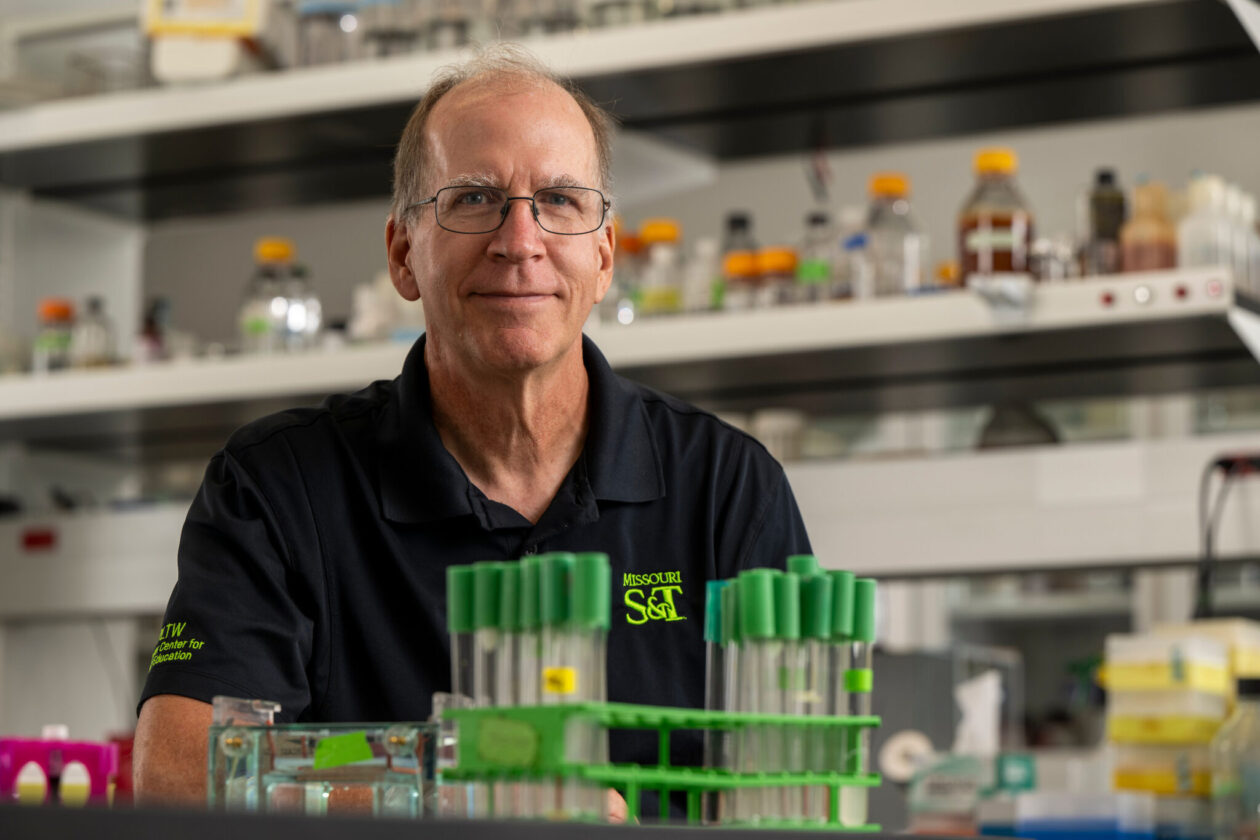
Dr. David Westenberg, Curators’ Distinguished Teaching Professor of biological sciences. Photo by Michael Pierce, Missouri S&T.
Chronic wound infections are a longstanding issue that affects hospitals and patients, because the bacteria that are associated with these infections often form complex “biofilms,” in which the microbial organisms persist in the infection.
Dr. David Westenberg, Curators’ Distinguished Teaching Professor of biological sciences at Missouri University of Science and Technology, and graduate student Sarah Fakher, are studying the antibacterial effectiveness of commonly used bioactive materials to see what is most effective against common infections like Staph infections and E. coli.
Bioactive materials are substances used in tissue regeneration and repair to create a beneficial response. They interact with living cells to create new tissue, usually bone, through regenerative medicine.
“Chronic wounds are often complicated by communities of bacteria that shield the bacteria from antibiotics and the immune system,” says Westenberg. “This can lead to persistent and hard-to-treat infections.”
The researchers’ most recent study tested antibacterial and antibiofilm effectiveness of four bioactive wound healing materials. The team found that antibiofilm effectiveness varied greatly in both the materials tested and among the different bacterial species. Copper and zinc-treated bioactive glass showed the most promise in improving wound treatment.
Fakher, who earned bachelor’s and master’s degrees in biological sciences and will soon start a Ph.D. in bioengineering at Missouri S&T, has even won a research award at the university for a project titled “Metal-ion Doped Borate Bioactive Glasses — A Novel Direction in Minimizing Nosocomial Infections and Antibiotic Resistance.”
Her poster presentation highlighted a small part of the research done at S&T on the subject, which is all based on the work by Dr. Delbert Day, Curators’ Distinguished Professor emeritus of ceramic engineering. An expert in developing specialty glasses for use in health care, transportation infrastructure and other applications, Day is known for co-inventing radioactive glass microspheres, now marketed under the brand name TheraSphere, which are used commercially at over 200 sites worldwide to treat patients with inoperable liver cancer.
Day’s glass treatments consist of injecting millions of the irradiated tiny beads – each one about one-third the thickness of a human hair – into the main artery supplying blood to the liver. The radioactive beads then deliver localized radiation to malignant cells without harming the surrounding healthy tissue. Day and co-inventor Gary J. Ehrhardt of the University of Missouri-Columbia started their research on the glass beads in 1982 and received their first patent for the beads in 1988.
Westenberg based his work on MO SCI’s work with Day, and says that his team’s research highlights the need for wound care materials that combine antimicrobial and healing-promoting properties to better manage chronic infections effectively.
“Among the tested materials, borate bioactive glass enhanced with copper and zinc showed the strongest antibacterial activity,” says Westenberg. “This can be attributed to the controlled release of copper and zinc ions that damage bacterial cells and stops the formation of bacterial communities, supporting faster wound healing.”
He also says that graduate students like Fakher show how research is a team effort, basing biological research on ceramic engineering work to provide future opportunities for biomedical advances.
“It’s the product of being at S&T, you have these sorts of collaborative opportunities for research,” says Westenberg. “These advancements in engineering-adjacent fields would not happen without the work that our faculty and students in the College of Arts, Sciences, and Education do – they add up and really highlight biological sciences’ role in interdisciplinary research.”
About Missouri S&T
Missouri University of Science and Technology is a STEM-focused research university of over 7,000 students located in Rolla, Missouri. Part of the four-campus University of Missouri System, Missouri S&T offers over 100 degrees in 40 areas of study and is among the nation’s top public universities for salary impact, according to The Wall Street Journal. For more information about Missouri S&T, visit www.mst.edu.


Leave a Reply