Supersonic success: S&T scholars sharpen wind tunnel simulations
Posted by Greg Edwards
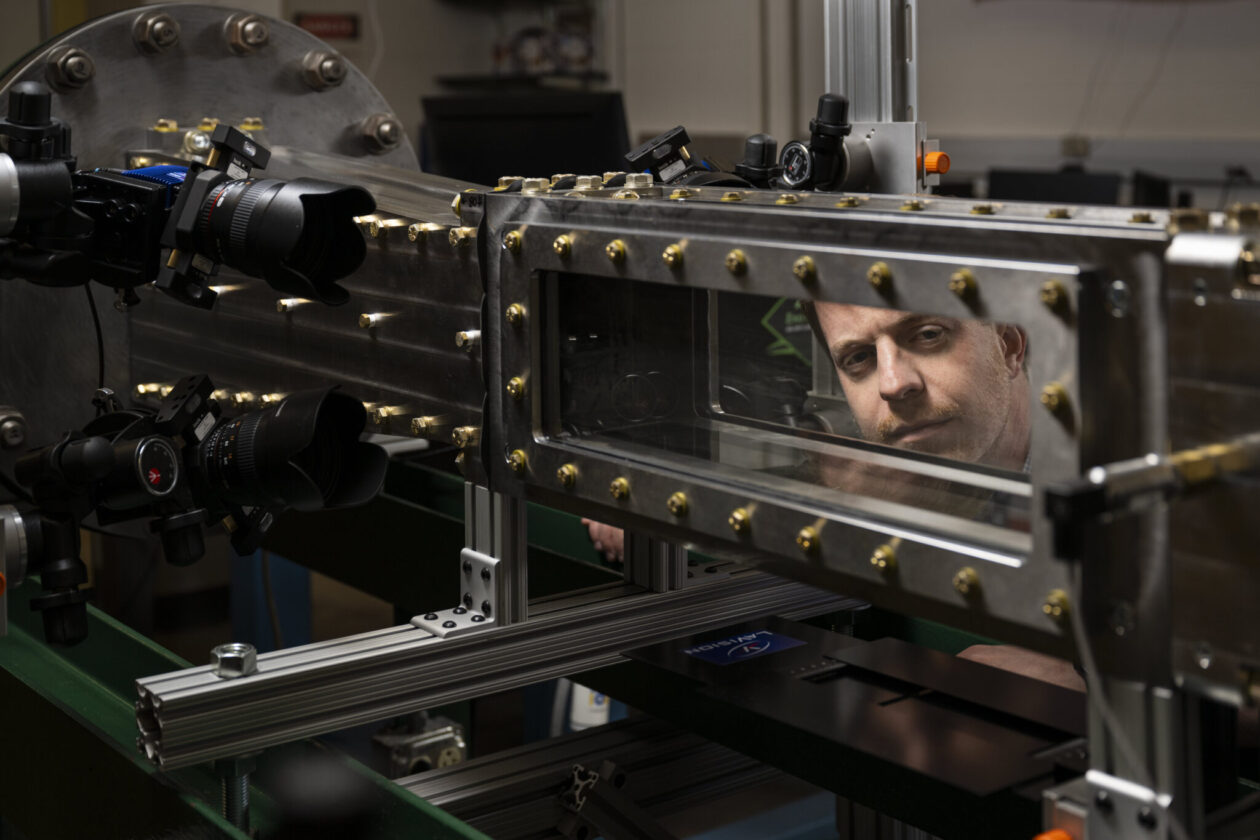
Dr. Davide Viganò examines Missouri S&T’s supersonic wind tunnel. Photo by Blaine Falkena/Missouri S&T.
Researchers at Missouri S&T have developed a more accurate way to predict conditions inside wind tunnels that are used to study how air behaves at speeds up to four times faster than the speed of sound, or over 3,000 miles per hour.
“Traditional approaches to predicting conditions in supersonic wind tunnel tests have simplified the physics, so they haven’t fully captured changes in temperature and other factors,” says Dr. Davide Viganò, an assistant professor of aerospace engineering at Missouri S&T. “Because we rely on those models to predict test conditions, even small changes in temperature can affect the conditions we think we’re creating. By accounting for those effects, we can now much more accurately predict the wind tunnel performance.”
Viganò says getting these conditions as precise as possible is important because inaccurate wind tunnel conditions can affect how high-speed aircraft and other aerospace systems are tested. More accurate predictions help engineers better understand airflow, which can improve performance and safety.
For his study published in The Aeronautical Journal, Viganò developed a physics-based computational model that predicts conditions inside the wind tunnel and accounts for factors such as heat transfer, pressure losses and how air behaves under extreme conditions. He then compared those predictions with data collected from the university’s supersonic wind tunnel — and he says the results were significant.
“We were able to reduce the difference between our predicted temperatures and what we actually measured from roughly 10% with traditional methods to less than 2% with our new model,” Viganò says. “That’s a strong improvement and can give aerospace engineers much more confidence that what they’re predicting matches what’s actually happening.”
Noah Cain, a 2024 Missouri S&T aerospace engineering graduate, supported Viganò’s work on the study as a Dean’s Undergraduate Research Scholar for Missouri S&T’s College of Engineering and Computing and was a co-author of the paper.
“This project involved us essentially recreating extreme flight conditions in a lab environment,” says the Granite City, Illinois, native. “Being able to control that flow and study it in detail is fascinating and really helps you understand how air behaves at high speeds.”
Cain, who is now a Ph.D. student at the University of Kansas, says he appreciates how he was able to directly contribute to research as an undergraduate student.
“Getting to be involved in this kind of work before I even graduated and be published in a journal has been an amazing opportunity,” he says. “Experiences like this are what makes S&T stand out and shows how the university prepares its graduates for successful careers.”
To learn more about Missouri S&T’s aerospace engineering programs, visit mae.mst.edu.
About Missouri S&T
Researchers at Missouri S&T have developed a more accurate way to predict conditions inside wind tunnels that are used to study how air behaves at speeds up to four times faster than the speed of sound, or over 3,000 miles per hour.

Posted by Greg Edwards
 Sports Headlines
- 2026 Miner Athletic Hall of Fame Induction Class Announced
- S&T Men's Basketball Earns Team Academic Excellence Awards; Five Miners Named to Honors Court
- S&T Men's Volleyball Earn AVCA Team Academic Award
- Ten Miners and Both Teams Earn USTFCCCA All-Academic; Fraser Named Scholar Athlete of the Year
- S&T Welcomes Ryan Hunt as New Assistant Track & Field Coach
Leave a Reply