Missouri S&T researchers identify carbon release risk tied to rising seas
Posted by Greg Edwards
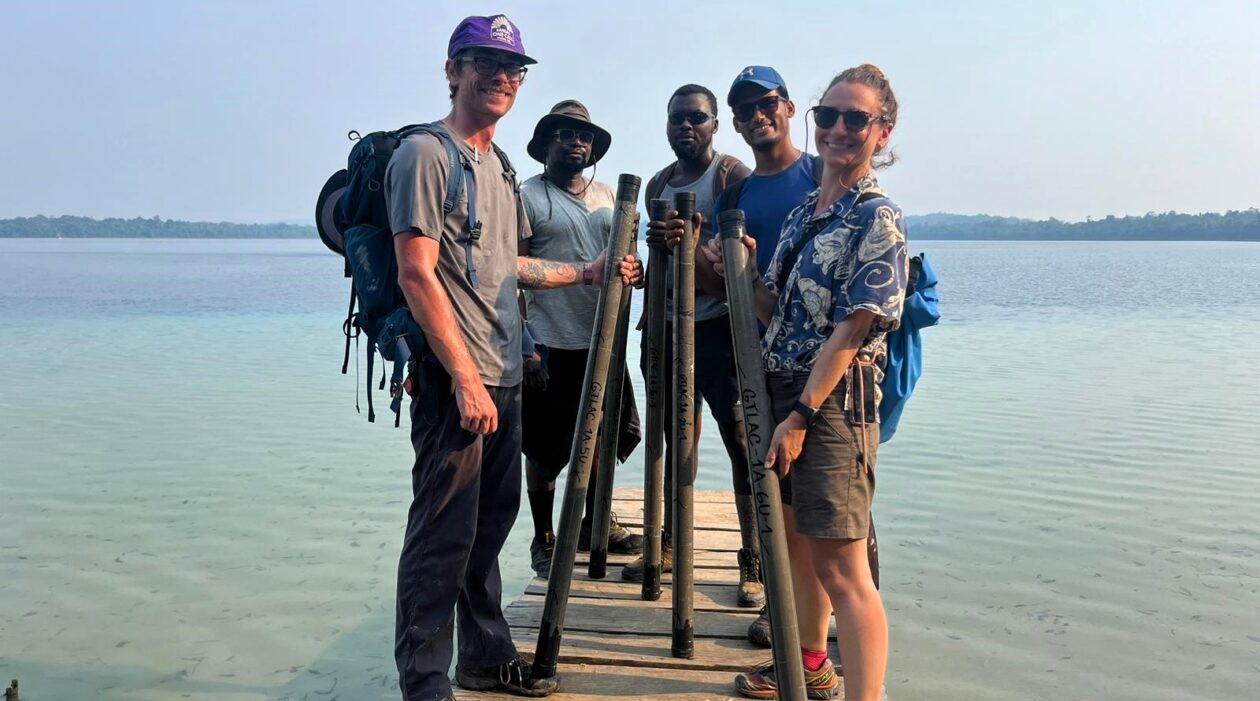
From left, Missouri S&T Ph.D. students Trenton McEnaney, Oluwakunle Moyofoluwa Ogunsakin, Linus Victor Anyanna and Suvrajit Ghosh, along with Dr. Marta Marchegiano from the University of Granada, Spain, hold sediment cores they collected during a field expedition in Guatemala. Photo courtesy of Ghosh.
Rising sea levels could do more than flood coastlines. Research from Missouri S&T shows they may also trigger the release of large amounts of carbon stored in coastal ecosystems into the atmosphere.
“What’s fascinating is that this process can become a self-reinforcing loop,” says Suvrajit Ghosh, a geology and geophysics Ph.D. student at Missouri S&T. “Rising sea levels can trigger carbon release, and that release can further accelerate changes that lead to even more sea-level rise.”
Ghosh and Dr. Jonathan Obrist-Farner, an associate professor of earth sciences and engineering at S&T, published an article in the journal Science of the Total Environment based on the chemical analysis of approximately 9,500 years of sediment cores, or long columns of layered organic material, S&T researchers collected from Lake Izabal in Guatemala.
According to Ghosh, Lake Izabal was an ideal site for the study because it has experienced repeated interactions between freshwater and seawater over time, including past events when seawater moved through nearby waterways into the lake and surrounding wetlands.
“It’s almost like opening a history book,” he says. “Each layer records environmental conditions at the time it was deposited, allowing us to look back thousands of years. These layers act as a natural archive, preserving records of environmental conditions over long periods.”
By analyzing the chemical composition of these layers, the researchers were able to track how carbon storage changed over time and during past flooding events. In some cases, when seawater entered the lake, its high sulfate concentration accelerated the breakdown of organic material, and up to 90% of the stored carbon was released into the atmosphere.
“Even though we’re looking at thousands of years of history, these records help us understand what could happen well into the future and how we can better prepare,” Ghosh says. “They show how sensitive these systems are and why it’s important to anticipate changes that could one day affect coastal ecosystems, infrastructure and communities.”
The research was part of a study that included co-authors from eight institutions across six countries.
To learn more about Missouri S&T’s geology and geophysics programs, visit ese.mst.edu.
About Missouri S&T
Missouri University of Science and Technology (Missouri S&T) is a STEM-focused research university of over 7,000 students located in Rolla, Missouri. Part of the four-campus University of Missouri System, Missouri S&T offers over 100 degrees in 40 areas of study and is among the nation’s top public universities for salary impact, according to the Wall Street Journal. For more information about Missouri S&T, visit www.mst.edu.

Posted by Greg Edwards
 Sports Headlines
- 2026 Miner Athletic Hall of Fame Induction Class Announced
- S&T Men's Basketball Earns Team Academic Excellence Awards; Five Miners Named to Honors Court
- S&T Men's Volleyball Earn AVCA Team Academic Award
- Ten Miners and Both Teams Earn USTFCCCA All-Academic; Fraser Named Scholar Athlete of the Year
- S&T Welcomes Ryan Hunt as New Assistant Track & Field Coach
Leave a Reply