College of Engineering and Computing
Fahrenholtz takes over Materials Research Center
Dr. William Fahrenholtz, Curators’ Professor of ceramic engineering at Missouri University of Science and Technology, has been named the director of the Materials Research Center at Missouri S&T. His appointment took effect Monday, March 21.
Fahrenholtz takes over for Dr. Matt O’Keefe, who became chair of materials science and engineering department at Missouri S&T on March 1.
“Dr. Fahrenholtz’s work as a professor of ceramic engineering has been exemplary, and he is one of the leading researchers in his field, making him an excellent choice to lead the MRC,” says Dr. Mariesa Crow, vice provost for research at Missouri S&T. “His move from senior investigator to director will ensure that the MRC remains on the cutting edge, helping prepare our students to tackle the challenges of today — and beyond.”
Read More »Nineteen Missouri S&T undergraduates to exhibit research to state legislators
Undergraduates from Missouri University of Science and Technology will travel to Jefferson City, Missouri, to exhibit their latest research projects to the state’s top legislators on Tuesday, March 15.
Read More »Missouri S&T Miners in Space develop NASA anchor
If astronauts are ever going to travel to and land on Mars, the first step is capturing a piece of an asteroid, putting it into orbit around the moon and having space walkers explore it. And Missouri University of Science and Technology students are designing a device that allows astronauts to safely move around on just such a rock.
Missouri S&T’s Miners in Space team is participating in NASA’s Micro-g NExT design challenge, and team members have developed an anchoring device that attaches to the surface that astronauts can clip onto. As part of NASA’s asteroid redirect project (ARM), the agency wants new technologies to use on a human mission to the Martian system in the 2030s.
But first, walking around on a piece of an asteroid has its own set of problems.
Read More »Missouri S&T to host concrete conference
Missouri University of Science and Technology will host the annual Missouri Concrete Conference May 3-4 in the Havener Center on campus. Conference registration is $140 per person.
Conference topics include benefits of macrofibers; steel fibers in concrete; impact of air pollution control on fly ash; proper curing techniques and materials; soil stabilization and full-depth reclamation; a Kansas City International Airport runway case history; new ACI pavement construction guide; lithium silicate curing compound; floor slabs and toppings: design and quality control; concrete tests: choices and interpretation; practical applications of resistivity testing; super air meter; factors affecting strength; structural cracks: identification, prevention and repair; street deterioration repairs; city and county: concrete pavement management programs; pavement joint sealing and resealing; pavement joint detailing; and history of Missouri Department of Transportation concrete girders.
Read More »Missouri S&T big data certificates ranked second in nation
Missouri University of Science and Technology’s Business Analytics and Data Science graduate certification program is ranked second in the nation in Value College’s Top 50 Best Value Online Big Data Graduate Programs of 2016.
The rankings list Carnegie Mellon University first, followed by Missouri S&T, which also offers graduate certificate programs in Big Data and Security and Big Data Management and Analytics. The programs are offered as part of distance and continuing education through Missouri S&T’s business information and technology department.
Read More »

Missouri Project Lead the Way reaches milestone with 500th program
With the addition of Cor Jesu Academy of St. Louis, Missouri’s Project Lead the Way initiative has reached 500 programs in elementary and secondary schools across the state.
Read More »Missouri S&T professor aims to improve self-consolidating concrete
A Missouri University of Science and Technology researcher is studying how to make concrete that can be placed without a lot of human intervention, and that can be poured in hard-to-reach places where people can’t easily manipulate it.
Dr. Dimitri Feys, assistant professor of civil, architectural and environmental engineering at Missouri S&T, is working with self-consolidating concrete to produce beams that can be used to construct bridges, parking garages or other construction. Self-consolidating concrete is a type that flows easily in concrete forms or molds.
“The main use of this concrete is in Japan and Europe — 100 percent of the pre-cast industry in Denmark uses this type — and it slowly is making its way in the U.S. market,” he says.
But there are challenges, Feys says.
Read More »

STEM superhero
Steph Evans is out to change the way people look at engineering – and at engineers.
Read More »Doe Run Co. donates mining equipment to Missouri S&T
The Doe Run Co. (Doe Run) recently donated $37,724 in technical equipment to the mining engineering department at Missouri University of Science and Technology to aid in training the next generation of mining engineers.
Read More »
Missouri S&T students fare well in Materials Bowl
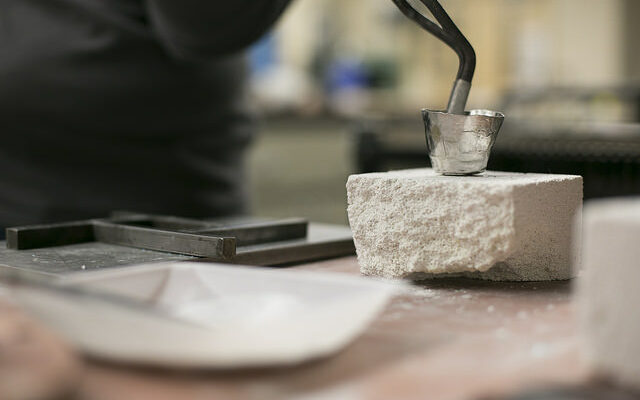
Four Missouri S&T students put their knowledge of materials science to the test last weekend, finishing second in a Jeopardy!-style quiz game, the TMS Materials Bowl.
Read More »