Engineers Week Q&A: Dr. Özgür Satici helps future engineers stand on solid ground
Posted by Greg Edwards
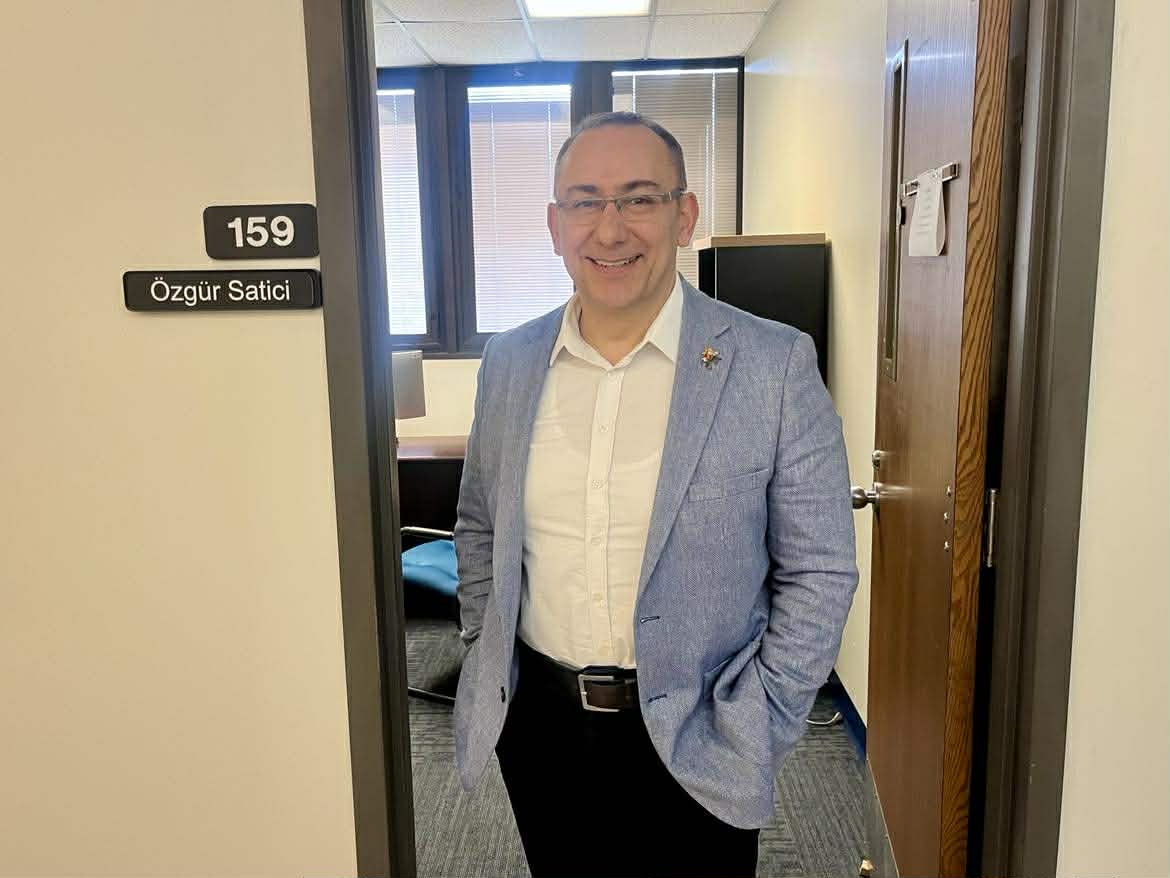
Dr. Özgür Satici stands outside his office in McNutt Hall. Photo by Greg Edwards/Missouri S&T
Dr. Özgür Satici joined the Missouri S&T faculty as an associate teaching professor of geological engineering in January 2025. Here is a Q&A with Satici in commemoration of National Engineers Week 2026.
How would you describe the field of geological engineering, and why is it important to modern infrastructure and society?
Geological engineering is a fundamental scientific discipline. Because it provides raw materials for all types of construction materials and because all construction materials interact with the Earth, understanding the engineering properties of rocks, soils and groundwater is essential. This knowledge enables us to design and build safe, environmentally responsible and economical structures and to use the world’s limited resources effectively and efficiently. By its nature, geological engineering is an interdisciplinary field that requires close coordination with civil, environmental, mining, petroleum and even mechanical engineering. Owing to its contribution to the efficient and economical use of limited resources, it is also a profession with a strong societal dimension.
Before joining Missouri S&T, you worked for several years on large-scale infrastructure projects and held leadership roles with the General Directorate of Highways in Turkey. How have your industry experiences influenced your approach to teaching and working with students?
I began my career immediately after graduation as a young engineer at the General Directorate of Highways. There, I had the opportunity to apply in practice the knowledge I had gained as a university student. Because the institution is Turkey’s largest public infrastructure investor, I was involved in major projects, including one of the world’s longest bridges and several of the country’s longest highway tunnels, as well as numerous roadway projects. I contributed to both the design phases and the on-site resolution of problems during construction, developing practical and timely solutions. These experiences later provided a strong foundation and significant advantages in my academic work.
My current goal is to share my field experience, together with the academic knowledge I have developed, with young engineering students in an international environment and, if possible, to contribute to the advancement of society. Young engineers are improved versions of ourselves, and they will use the knowledge and experience they gain from us even more effectively in their professional careers.
I would also like to share something personally meaningful to me. The General Directorate of Highways was founded in 1950 by its first director general,Vecdi Diker. I learned only after coming here that he graduated from the University of Missouri before returning to Turkey to establish the institution. After many years working in the organization he founded, beginning my academic career as part of the same university system from which he graduated has been a great source of pride and happiness for me.
What aspects of geological engineering do you find most fascinating?
Geological engineering requires close collaboration with many different disciplines. As a result, beyond your formal title, working with professionals from diverse fields helps you develop a strong body of knowledge and experience and enables you to approach engineering problems from multiple perspectives. Moreover, because the profession often requires fieldwork, it offers opportunities to visit natural landscapes that you might not otherwise have the chance to see, as well as to build new friendships in different regions and experience local cultures and cuisines.
What advice would you give students interested in pursuing careers in geological engineering?
My advice to our students is not to limit themselves to a single area of specialization. They should pursue graduate studies in fields related to their interests so that they can enrich the knowledge gained during their undergraduate education from different perspectives. I also encourage them to view fieldwork as an opportunity. Just as every person has unique characteristics, each geological or geotechnical problem in the Earth requires its own specific solution. The more diverse problems and ground conditions they encounter, the stronger their practical problem-solving skills will become.

Posted by Greg Edwards
 Sports Headlines
- 2026 Miner Athletic Hall of Fame Induction Class Announced
- S&T Men's Basketball Earns Team Academic Excellence Awards; Five Miners Named to Honors Court
- S&T Men's Volleyball Earn AVCA Team Academic Award
- Ten Miners and Both Teams Earn USTFCCCA All-Academic; Fraser Named Scholar Athlete of the Year
- S&T Welcomes Ryan Hunt as New Assistant Track & Field Coach
Leave a Reply