Engineers Week Q&A: Clark Nguyen’s research ‘steels’ the show
Posted by Greg Edwards
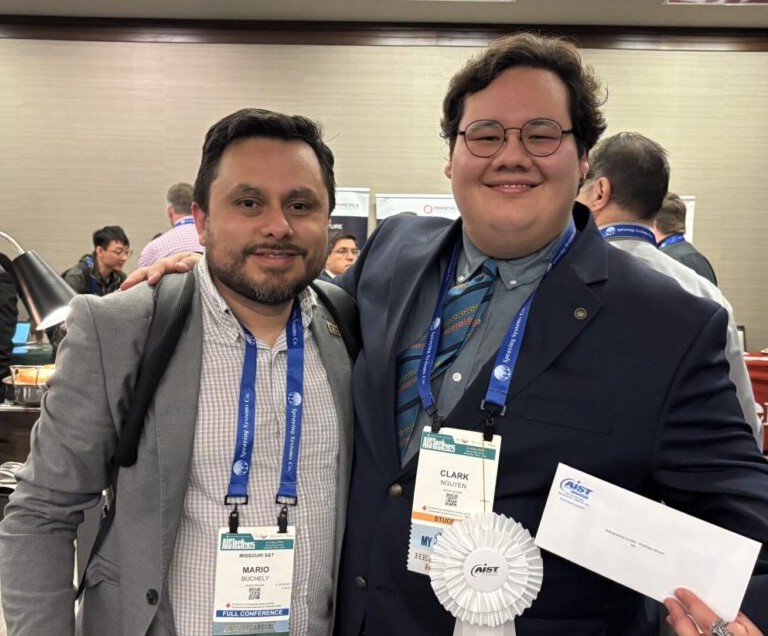
Clark Nguyen, right, poses with his advisor, Dr. Mario Buchely, a Roberta and G. Robert Couch Assistant Professor of materials science and engineering at S&T. Photo courtesy of Buchely
Clark Nguyen earned a bachelor’s degree in metallurgical engineering at Missouri S&T in December 2025 and began his Ph.D. program in materials science and engineering this spring. Here is a Q&A with Nguyen in commemoration of National Engineers Week 2026.
How would you describe what metallurgical engineering entails, and why is it important to everyday life?
Metallurgical engineering is the study of how metals are produced, processed and engineered to achieve specific properties for real-world applications. It connects the microscopic structure of materials, such as grain size, crystal orientation and composition to the macroscopic performance we depend on every day. Metals support nearly every aspect of daily life, from buildings, bridges and vehicles to electrical transformers, motors and renewable energy systems. The efficiency of power grids, the safety of infrastructure and the advancement of emerging technologies like electric vehicles all depend on metallurgical engineering. Without metallurgical engineers, we would not have the reliable materials necessary to sustain modern civilization.
You are now a Ph.D. student at Missouri S&T, but you first became involved in research at the Kent D. Peaslee Steel Manufacturing Research Center while completing your bachelor’s degree. What aspects of steel research and metallurgy do you find most fascinating?
I first became involved with the Kent D. Peaslee Steel Manufacturing Research Center during my sophomore year when I met Dr. Mario Buchely in my introduction to manufacturing class. At the time, I was interested in additive manufacturing, but through my coursework and early research exposure, I realized that what fascinated me most was not just how parts were made, but the materials themselves. I became increasingly interested in understanding how metals behave and how their properties can be controlled through processing.
Regarding steel research, I found my collaborative work with Steel Dynamics Inc. on the effects of heat treatment on steel particularly interesting, especially in understanding how different heating and cooling cycles influence the mechanical properties of materials. Seeing how controlled thermal processing could strengthen steel, improve its durability or alter its microstructure helped me understand the direct relationship between processing, structure and performance. What continues to fascinate me most about steel research is that even small changes in temperature, composition or processing conditions can lead to measurable and meaningful differences in material behavior. It is incredibly rewarding to study these relationships and contribute to improving a material that plays such an important role in modern infrastructure, energy and manufacturing.
What influenced your decision to continue your education at Missouri S&T after earning your bachelor’s degree in metallurgical engineering in December 2025?
My decision to continue my education at Missouri S&T was strongly influenced by the mentorship and research experience I gained while working with my advisor, Dr. Mario Buchely. We have worked together for several years with very meaningful results, and his guidance helped me develop both my technical knowledge and confidence as a researcher.
One of the highlights of my undergraduate experience was earning third place in the Association for Iron and Steel Technology (AIST) Undergraduate Student Speaking Contest at AISTech. This is a highly competitive international competition where undergraduate students are selected based on their technical knowledge, research quality and presentation skills. Being recognized at that level reinforced my passion for steel research and showed me that I wanted to continue contributing to the field.
Additionally, the overall quality of the materials science and engineering department at Missouri S&T played a major role in my decision. The faculty, staff and research facilities provide an exceptional environment for advanced study, with access to equipment and expertise that support high-level research. Missouri S&T also offers strong connections with the steel industry, which creates opportunities to conduct impactful, industry-relevant research. Continuing my education here allows me to build on the research foundation I developed as an undergraduate and pursue my growing interest in electrical steels. These materials are essential for modern energy systems, and I am excited by the opportunity to contribute to improving their performance and efficiency through advanced research.
The 2026 Engineers Week theme is “Transform Your Future.” How do you see your work as a metallurgical engineer contributing to that future?
My work focuses on improving electrical steels, both non-oriented electrical steels (NOES) and grain-oriented electrical steels (GOES). These are critical materials that enable electric motors, power transformers and modern energy systems. Electrical steels are essential for electrification because they make it possible to efficiently convert and transmit electrical energy and support technologies such as electric vehicles, renewable energy generators, and power grid infrastructure. By advancing the metallurgy of both NOES and GOES, my research supports more efficient electrification, stronger integration of renewable energy and more sustainable steel manufacturing. Transforming the future begins at the materials level, and my work contributes to developing the critical materials that make that transformation possible.
What advice would you give students who are considering studying metallurgical engineering?
My advice to students considering metallurgical engineering is simple: go for it. It is a field that offers incredible opportunities to learn, grow and make a meaningful impact. At Missouri S&T, the metallurgical engineering department provides strong support through scholarships, hands-on learning and access to research opportunities. Students can work closely with faculty who are leaders in the field, which allows them to develop both technical knowledge and real research experience early in their careers.

Posted by Greg Edwards
 Sports Headlines
- 2026 Miner Athletic Hall of Fame Induction Class Announced
- S&T Men's Basketball Earns Team Academic Excellence Awards; Five Miners Named to Honors Court
- S&T Men's Volleyball Earn AVCA Team Academic Award
- Ten Miners and Both Teams Earn USTFCCCA All-Academic; Fraser Named Scholar Athlete of the Year
- S&T Welcomes Ryan Hunt as New Assistant Track & Field Coach
Leave a Reply