When the lights went out, the show went on: S&T theatre students take “RACE’S END” outdoors
Posted by news
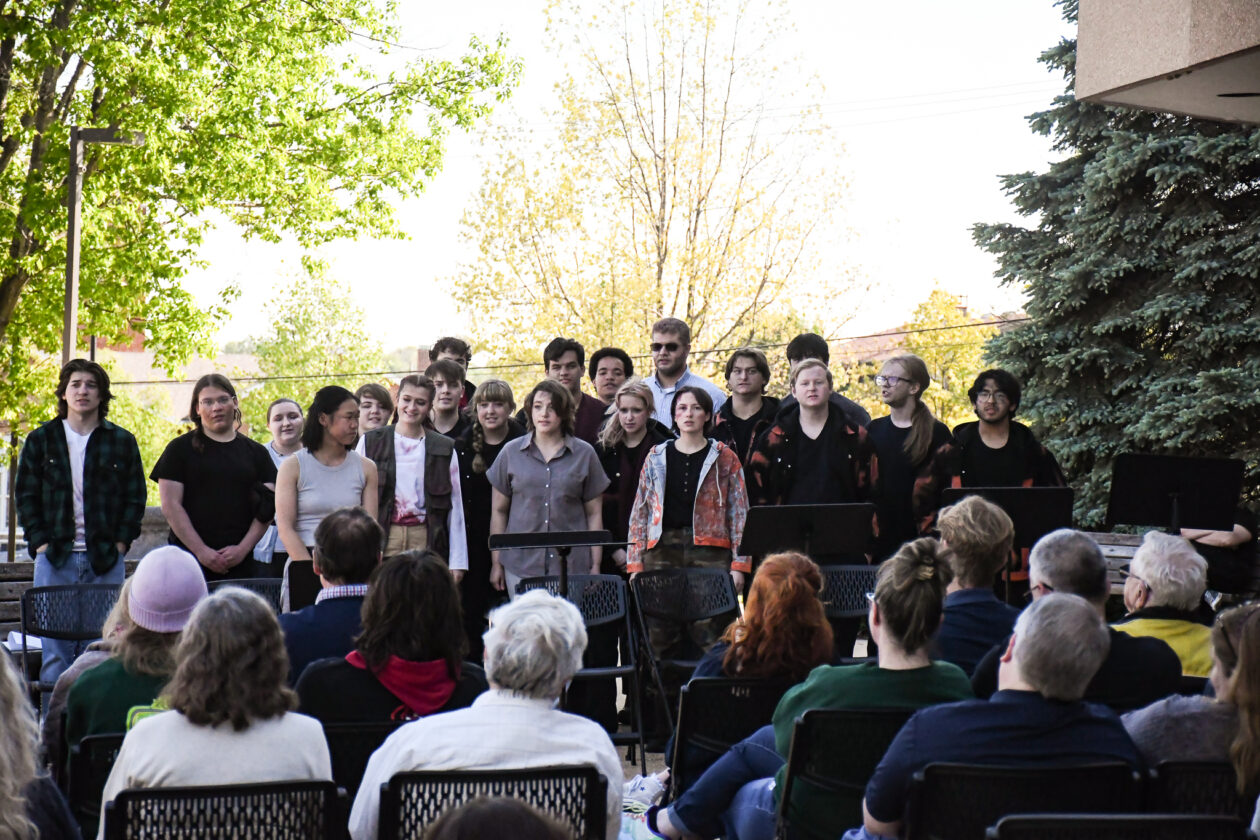
Photo of the performance. Photo submitted by Taylor Gruenloh.
The following was written by Taylor Gruenloh, assistant professor of theatre, and submitted for the CASE April 2026 Newsletter.
When the power went out across much of Rolla on Sunday afternoon, April 19, Missouri University of Science and Technology theatre students faced a choice: stop the show or adapt in real time.
They chose to keep going.
About 20 minutes into the second act of Race’s End, a new play written specifically for Missouri S&T students, a sudden power outage at Castleman Hall halted the production’s technical elements including lighting, sound, and projections that were central to the performance. Within minutes, students and faculty pivoted, relocating the audience outdoors to continue the show under clear skies.
What followed was an impromptu transformation of a technology-driven production into a minimalist, reader’s theatre style performance, a shift that echoed the play’s own themes of technological reliance and resilience in the face of uncertainty.
“It was like tripping back in time,” says Taylor Gruenloh, assistant professor of theatre. “We went from state-of-the-art technical theatre special effects, with smoke and projections, surround sound and intense lighting design, to being outside, and only having the sunlight and our voices. Kind of Shakespearean.”
Students quickly brought chairs outside Castleman Hall, reorganizing the audience while maintaining the continuity of the performance. Stage manager Abigail Lebar adapted on the fly, narrating stage directions and visual elements that could no longer be seen.
The result was a stripped-down version of the production that relied entirely on performance and storytelling.
“After spending months on the technical design of this show, a show that was supposed to be told through big effects and bold spectacle, it was kind of rewarding to know that the emotional impact was still felt when it was just us outside saying the lines,” says Lebar, an engineering management major.
Race’s End explores themes of technological dependence and the human response to existential uncertainty, making the real-world disruption an unexpected parallel to the story unfolding onstage.
For the student performers, the experience became less about what was lost and more about what remained.
“It’s deeply ironic that the show making a statement on humanity’s over-reliance on technology was briefly halted due to the technology we relied on failing. But it’s also very grounding,” says Josie Schnelten, an engineering management major.
Despite the sudden change, the performance continued to its conclusion, with the audience staying engaged throughout the outdoor staging.
The unexpected pivot became a demonstration of adaptability, a hallmark of both engineering and the performing arts at Missouri S&T, and a reminder that even without technology, storytelling endures.
In a production centered on the tension between humanity and technology, the outage offered a fitting, if unplanned, final lesson. When systems fail, people carry the story forward.

Posted by news
 Sports Headlines
- S&T Welcomes Ryan Hunt as New Assistant Track & Field Coach
- Missouri S&T Closes 2025-26 Season Atop Division II for Academic All-America Selections
- Cross Country Announces 2026 Season Schedule
- S&T Sydney Morris Earns Second Team Academic All-America
- Fraser Named CSC Academic All-America Team Member of the Year, Joins Born and Knittel on First Team
Leave a Reply