Once-hidden gems now sparkling at Missouri S&T Mineral Museum
Posted by Greg Edwards
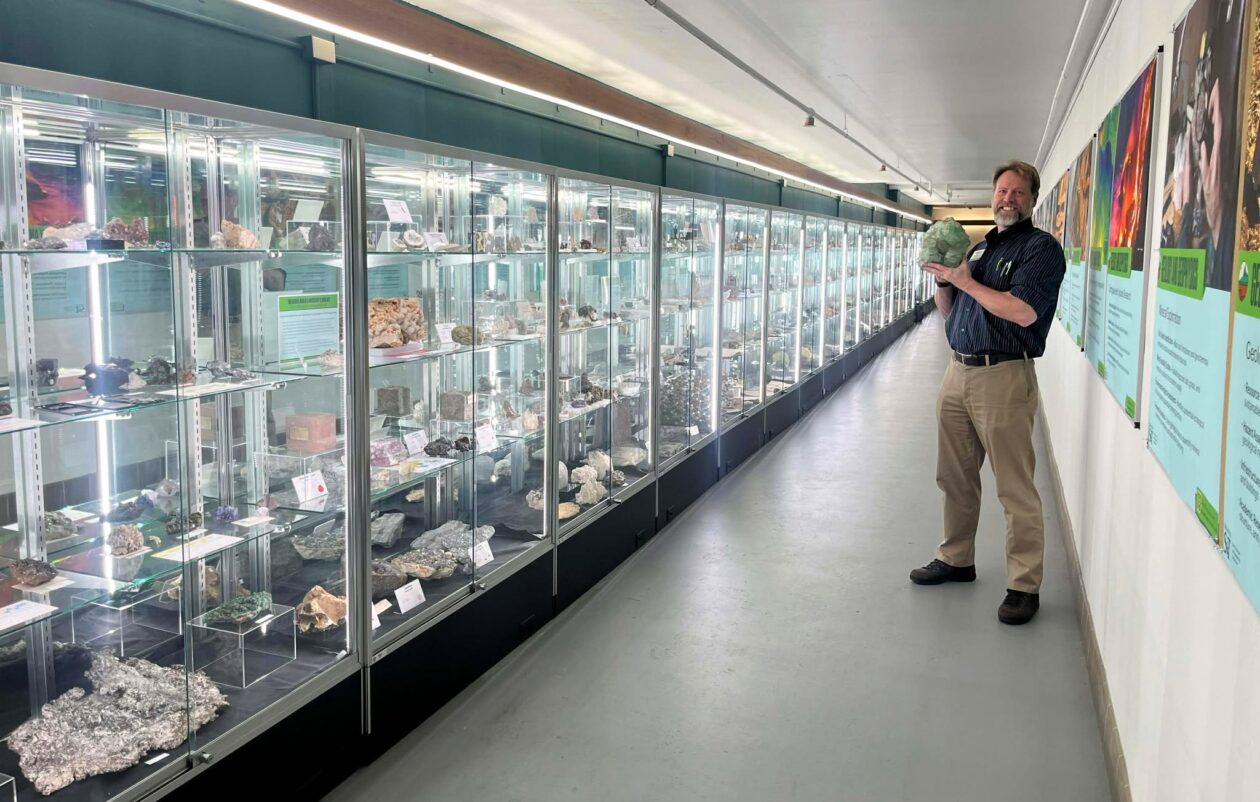
Peter Bachle, the museum’s curator, displays a large green fluorite crystal. He says fluorite is a primary ingredient in most toothpastes. Photo by Greg Edwards/Missouri S&T.
A quiet hallway on the first floor of Missouri S&T’s McNutt Hall is home to what could once have been considered thousands of hidden gems — but after recent updates to the Missouri S&T Mineral Museum, many have emerged from hiding and are now sparkling.
“When people visit the museum now, you can see their eyes light up immediately,” says Peter Bachle, an associate teaching professor of earth sciences and engineering at S&T and the museum’s curator. “Missouri S&T has always had some of the most amazing pieces you can find anywhere. Now they are displayed in a way that helps them really shine.”
For several decades, most of the museum’s 4,000-plus minerals from more than 90 countries were housed in wooden display cases and drawers.
With recent updates, many of those specimens now sit in modern glass cases with brighter lighting and mirrored backs that make colors, textures and crystal structures more visible. Many minerals are also arranged into themes to provide visitors with a learning experience as well.
“We wanted people to see that this isn’t just a hallway of pretty rocks,” Bachle says. “Many of these minerals are the same materials that support modern life, from construction and transportation to electronics and energy, and the displays help illustrate that.”
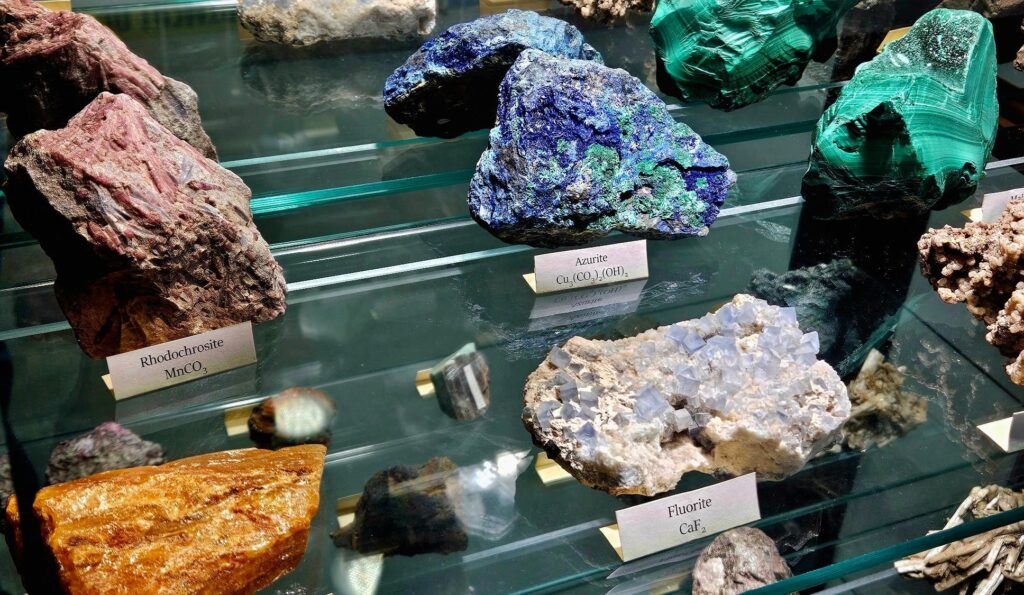
The museum’s exhibits feature everything from meteorites from space to minerals like galena from Missouri to a UV light display with glowing rocks.
Visitors can also see uranium ore with safe levels of radiation and a tooth used by a woolly mammoth to chew up grass and other plants during the Ice Age.
“What’s amazing is millions of people from throughout the world have previously laid eyes on a large amount of our minerals, but most of those viewings were over 120 years ago,” Bachle says. “A large amount of our specimens were donated to Missouri S&T after the 1904 World’s Fair, and the collection has continued to grow since then.”
Dr. Stephen S. Gao, a Curators’ Distinguished Teaching Professor and chair of earth sciences and engineering at S&T, says the upgrades to the museum would not have been possible without support from his department’s alumni and the university’s College of Engineering and Computing.
“We have always been very proud of the university’s remarkable mineral collection and have been eager to share it with anyone interested in science, history or the natural world,” Gao says. “These recent improvements make the museum more accessible to students and visitors, and the work is not finished. We plan to continue adding new glass cases, better lighting and updated exhibits so the museum keeps getting better and better.”
The museum is open Monday through Friday from 8 a.m. to 4:30 p.m. on the first floor of McNutt Hall on the S&T campus, and admission is free. Tours can be self-guided, or visitors can email Bachle at peter.bachle@mst.edu to arrange a tour with him.
To learn more about the museum, visit ese.mst.edu/mineral-museum.
About Missouri S&T
Missouri University of Science and Technology (Missouri S&T) is a STEM-focused research university of over 7,000 students located in Rolla, Missouri. Part of the four-campus University of Missouri System, Missouri S&T offers over 100 degrees in 40 areas of study and is among the nation’s top public universities for salary impact, according to the Wall Street Journal. For more information about Missouri S&T, visit www.mst.edu.

Posted by Greg Edwards
Leave a Reply
 Sports Headlines
- Baseball Wins Seventh Straight in 16-2 Rout of Harding
- Women's Basketball Places Four on CSC Academic All-District Team
- Young Adds Another Honor After Stellar Season; Named All-Region by NABC
- Beauchamp, Brown, and Young Earn CSC Academic All-District
- Baseball Hosting Harding; Rockhurst for Five-Game Homestand
I visited those minerals several times between 1973 and 1985 and always enjoyed them in Norwood Hall.
I once saw that exhibit was listed on a map of a sight to see.
Great article! Exciting to see the hidden gems now shining at the Missouri S&T Mineral Museum — looks like a fascinating collection!
Great they are on display properly now. remember seeing in the drawers in Norwood Hall when I was 4 or 5, the first visit to the campus I remember. My father helped label and catalog many of them in the 1930s as a “work – study” type job, and proudly showed off his work to us. My daughter showed them to us again about 10 years ago as a student, in Mcnutt hall but still in drawers.
Definitely will check out next week when I’m in Rolla