Engineers Week Q&A: Dr. Mariam Al-Lami and the power of plants
Posted by Greg Edwards
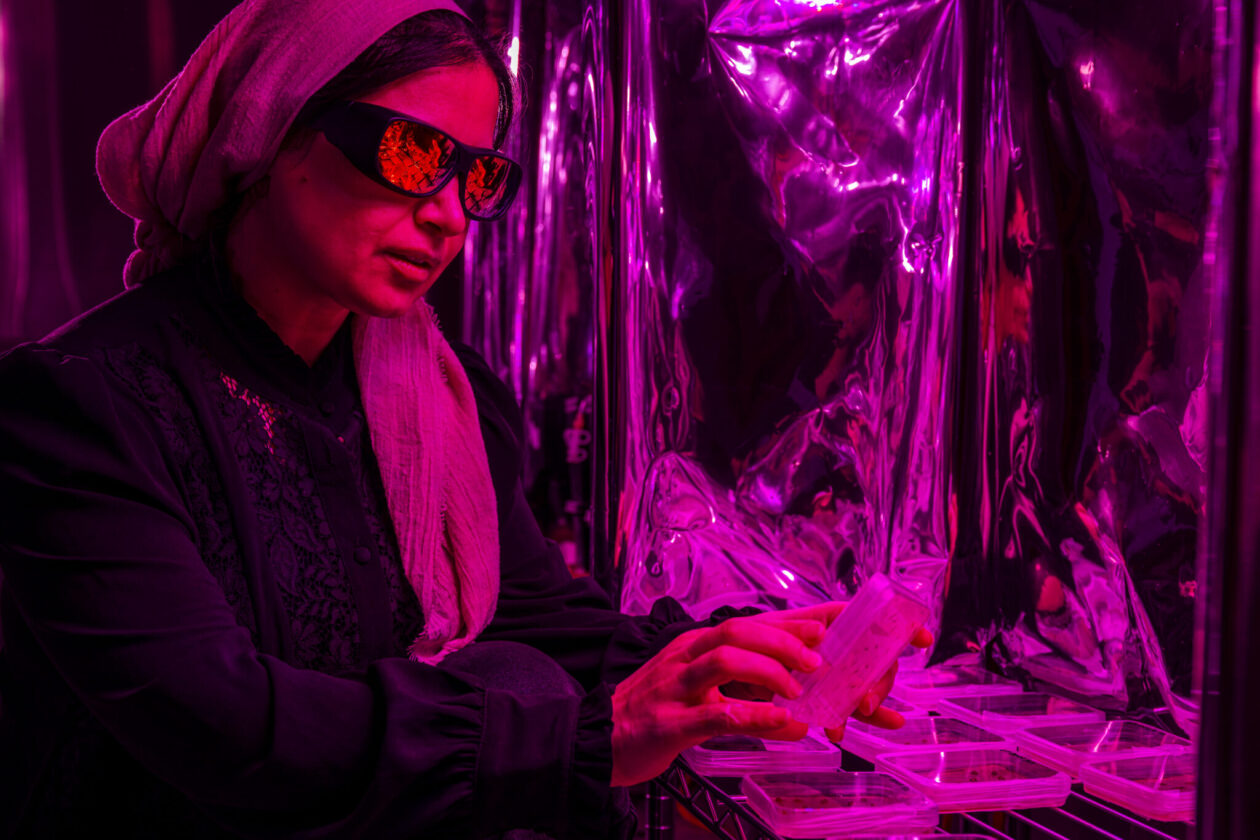
Dr. Mariam Al-Lami examines a tray of seeds in an indoor grow chamber. Photo by Michael Pierce/Missouri S&T.
Dr. Mariam Al-Lami earned a Ph.D. in environmental engineering at Missouri S&T in 2022 and is now an S&T postdoctoral fellow. Here is a Q&A with Al-Lami in commemoration of National Engineers Week 2026.
How do you describe your research in environmental restoration and critical minerals, and why is it important?
My research focuses on restoring mine-impacted lands by rebuilding soil function through revegetation. Many legacy tailings sites remain barren and can release metals through erosion and windblown dust, posing long-term environmental risks. At Missouri S&T, I study plant-based approaches and targeted amendment strategies that help reduce metal exposure risk, support sustainable vegetation and promote ecosystem recovery.
I also study how some legacy mine wastes might be safely reused as a source of critical minerals, which are in high demand for modern technologies. With Drs. Lana Alagha and Kwame Awuah-Offei in Missouri S&T’s mining engineering program, we’re evaluating greener extractants and how to reclaim remaining tailings after reprocessing. The goal is to reduce risk while supporting more sustainable resource use, which is an issue that’s relevant in southeast Missouri and in mining regions across the U.S. and globally.
What aspects of environmental engineering do you find most fascinating?
One of the most fascinating aspects of environmental engineering to me is the power of plants. Plants are not passive parts of a landscape; instead, they actively shape their surroundings through the chemical compounds released by their roots and plant–microbe–soil interactions. These processes drive biogeochemical transformations that influence contaminant fate, microbial communities, and carbon and nutrient cycling — ultimately supporting long-term soil health.
When I joined Missouri S&T for my Ph.D., I was particularly inspired by Dr. Joel Burken’s environmental forensics research using plants as sensors to detect subsurface pollutants. Seeing how living systems can both detect contamination and influence its fate led me to join his research group and focus my work on phytotechnologies. That experience shaped how I view environmental engineering not only as cleanup, but as designing cost-effective, environmentally friendly biological systems that restore stability and ecosystem function.
The 2026 Engineers Week theme is “Transform Your Future.” How does your work at Missouri S&T connect with this theme?
My work is centered on transformation — transforming mine-impacted soils into functional ecosystems and transforming legacy mine waste and industrial byproducts from liabilities into resources. My research translates laboratory findings into real-world impact by stabilizing contaminants, rebuilding soil function and developing strategies to valorize waste into usable products or tools for restoration.
This work also connects directly to community futures. Many legacy mine sites, including in southeast Missouri, have remained barren and erodible for decades in economically vulnerable regions. Reclamation that restores land function and supports responsible reuse or reprocessing can reduce long-term environmental risk while creating pathways for local employment, land redevelopment, and economic resilience.
“Transform Your Future” also reflects the training side of the work. As a postdoctoral fellow, I mentor undergraduate and graduate students in field and lab research, data interpretation, and scientific communication, helping prepare the next generation to lead sustainable restoration and resource recovery efforts.
You are a postdoctoral fellow at S&T. What are your goals for the future?
My long-term goal is to lead research that integrates biogeochemistry, ecological restoration and sustainable materials management. I’m especially interested in bridging lab-scale mechanisms with field-scale implementation by developing field-validated strategies to restore soil function at legacy mine sites, with clear performance metrics to guide reclamation decisions.
I also plan to expand work on environmentally responsible critical-mineral recovery from legacy mine waste, including effective reclamation pathways for residual tailings. Looking ahead, I’m interested in bio-based recovery approaches, such as phytomining and biomining, and in applying phytotechnologies to emerging contaminants such as PFAS, where plant–microbe–soil processes can support monitoring or risk mitigation. I ultimately aim to build interdisciplinary collaborations across academia, industry and federal partners while mentoring students and helping prepare the next generation of engineers and scientists in phytotechnology-based restoration, sustainable materials and critical-mineral recovery, and emerging contaminant mitigation.
What advice do you have for students interested in becoming environmental engineers?
Build a strong foundation in chemistry, biology, physics, statistics and data analysis. Environmental problems are complex, often linking processes across soil, water, air, ecosystems and human communities, which is why integrative and critical thinking matter as much as any single subject.
Get hands-on experience early. Join a lab as a research assistant, pursue internships and spend time working with real samples and real data. Field and lab experience will teach you things textbooks can’t. Ask questions, seek mentorship and collaborate, because the most impactful environmental solutions are interdisciplinary and team based.
Stay curious and adaptable. The environmental field evolves quickly with emerging contaminants, new monitoring tools and new sustainability goals, and the engineers who make the biggest impact are the ones who can connect mechanistic understanding to solutions that are practical, measurable, cost-effective and sustainable.


Leave a Reply