Engineers Week Q&A: S&T alumnus Malachi Rein works at the intersection of buildings and behavior
Posted by Greg Edwards
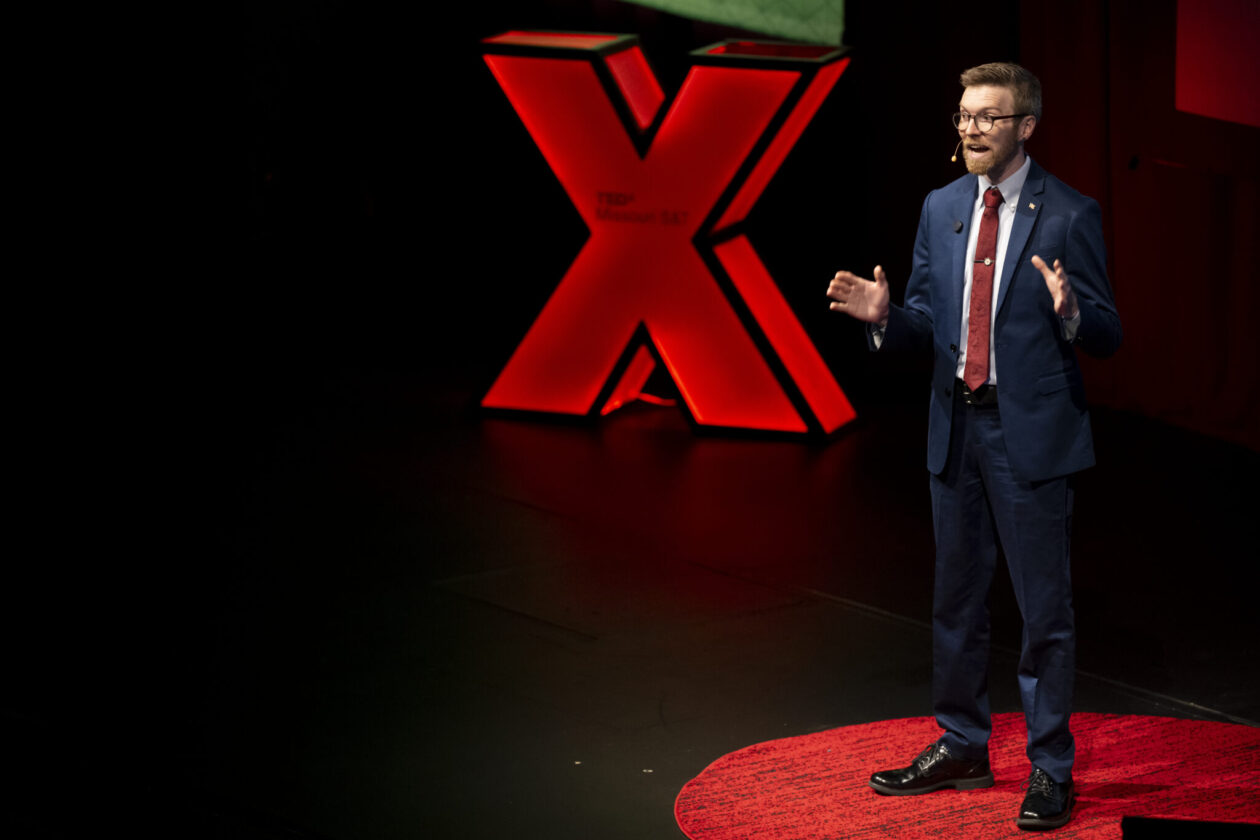
Malachi Rein speaks during the TEDxMissouri S&T 2024 event. Photo by Blaine Falkena/Missouri S&T
Malachi Rein, a 2016 Missouri S&T architectural engineering alumnus, is director of the Building Energy Exchange St. Louis. Here is a Q&A with Rein about community impact, energy efficiency and sustainable design in commemoration of National Engineers Week 2026.
How would you describe what you do as director of the Building Energy Exchange St. Louis?
Buildings are one of the most critical and intersectional things that humans interact with. They serve both as infrastructure and inspiration, home and community. They’re also technically complex, facing evolving challenges, and getting worse over time. Stakeholders have a wide variety of backgrounds, many without technical expertise. When the stakes are as high as they are with buildings, and the potential outcomes for doing things well are so amazing, we need to bridge the technical and the behavioral conversations to get projects moving. Most of my work is living at those intersections to support good decision making regardless of where you’re coming from or what your needs are.
This often involves collaborating with stakeholders such as utility providers; municipalities; those who design, construct and operate buildings; and the decision makers and users of the built environment. There are opportunities in every building for better performance, and there are timelines for which this makes sense. Connecting ideas, technological advances and partners through resourcing, technical expertise and capacity building is a vital component of asking stakeholders with varying knowledge to make a change or an investment.
In 2016, you earned a bachelor’s degree in architectural engineering at Missouri S&T. How did your time as an S&T student shape the way you think about buildings, communities and your career path?
While I was at Missouri S&T, I explored a lot of the history of the campus and the community. The buildings are at the intersection of that — both as a backdrop and as a participant with endless options for inspiring engineers and projects. Working with Dr. Stuart Baur and S&T facilities folks, along with doing research at the library and experiencing the current use of the buildings, I was able to contextualize their value in a more humanistic way than coursework alone allowed. The geothermal project was also in full swing during this time, and I could see how adaptation benefited the campus in many ways and understand how reducing overhead costs and maintenance needs allowed for more time and money invested elsewhere.
You’ve been recognized as a St. Louis Business Journal 40 Under 40 honoree and have presented a TEDx Missouri S&T talk. What motivates you to communicate engineering concepts to the public?
Engineering is first and foremost filling a societal need; it is a civic duty. I’d also like to note that this communication street should go both ways. We learn more about the nature of the questions we are trying to answer through engaging. We must be trusted experts — and that also means that we must be trustworthy. In an age of questioning expertise, elevating the importance of engineering is important, especially as many of the hard lessons are beyond living memory. Our charge is written in a lot of human pain and error, and those threats do not go away when we get trapped in the vitally important detail work that we often do.
It creates a challenge where communication is key, but we must look up and see the big pictures. It is whiplash if you are looking at a process every day and know it inside and out, then try to see how it fits into the world, behavioral science, long term health outcomes, climate change, etc. People are often good at one view or the other, and expertise has a lot to do with capacity. Engineers must avoid the pitfalls of not adapting to broad societal needs but also must act with the confidence of engineering experience and data.
The 2026 Engineers Week theme is “Transform Your Future.” How do you see engineers playing a role in transforming communities through energy efficiency and sustainable design?
I see engineers playing one of the most pivotal roles in transforming the future. We are necessary to adapt and innovate, to build towards the future that will happen. The challenge is continuing to learn and to challenge the boundaries of the questions we solve for. We can either be enablers through stagnation, or the catalyst for transformation that benefits humanity.
Only one of these options is the right one, and theoretically, it’s what we exist to do. It’s what we’ve always worked to do. Let’s look up at the big picture, elevate our goals, innovate and hold ourselves to the standards that we profess. There isn’t room in engineering for those who don’t. We make up an awesome field with endless possibilities. Stay centered in that reality and leverage it to build trust and interest, to engineer a future for those future engineers to contribute to.
What advice would you give current students who want to use engineering skills to make a meaningful impact in their communities?
Stay humble. Our work is collaborative, and our stakeholders don’t know what we know. We can learn from them in equal measure. Question the task and be considerate of how projects fit into a larger context. Advocate for better solutions wherever you land in your careers and be willing to flex to see things through different lenses.
Put the work where it needs to be to create amazing outcomes and also learn from the societal lessons of the past that gave us the foundations that we build upon. Be the engineers that would have inspired you through work, demeanor and commitment. Open doors for others because the field is bigger than any one of us. It is a noble thing to be an engineer and to serve humanity.


Leave a Reply