Retraining the membrane: S&T student’s award-winning research boosts algae growth
Posted by Greg Edwards
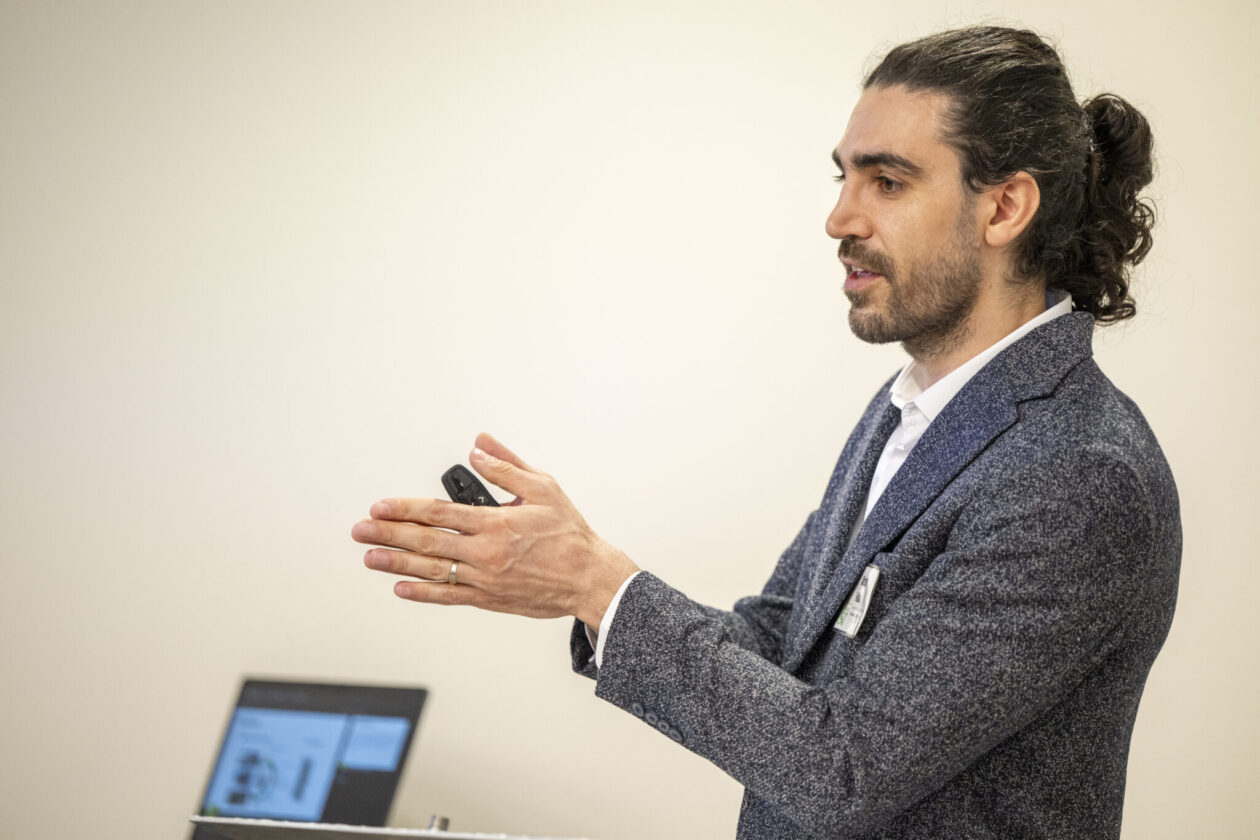
Alireza Fallahi speaks about his research during a Missouri S&T Kummer Day event. Photo by Michael Pierce/Missouri S&T Michael Pierce/Missouri S&T
Algae — the green, sometimes slimy-looking organisms found in bodies of water — could potentially be used as a commercial product to capture industrial emissions, serve as a biofuel and improve wastewater treatment.
But finding a cost-effective way to feed the algae with carbon dioxide so it can grow efficiently at a large enough scale for widespread use is a challenge.
Alireza Fallahi, a Missouri S&T Ph.D. student in mechanical engineering from Iran, has a plan to solve the challenge and received a Young Researcher Award for his research poster at the 2025 Algae Biomass Summit.
“As the world moves toward renewable and clean energy sources, microalgae technology will continue to be one of the key pieces of the puzzle,” says the Kummer Innovation and Entrepreneurship Doctoral Fellow. “The key will be determining how to most efficiently increase its mass, and my research is an exciting step in that direction.”
The annual Algae Biomass Summit, described as the world’s largest gathering of algae and seaweed professionals, was held this past fall in Tempe, Arizona. During the poster session, nearly 100 researchers competed for awards in engineering innovation, biological innovation, research methods and design, and resourceful, resilient research.
Fallahi was honored for engineering innovation.
He says his research has focused on optimizing the rotating membrane inside a photobioreactor, which is essentially a tank used to grow algae and deliver carbon dioxide into the system.
“Carbon dioxide naturally has trouble moving from air into water, so it needs a bit of a helping hand to get to the levels we need,” Fallahi says. “That’s why I have worked to use computer modeling and experiments to find better ways to get the gas into the algae-growing system.”
As the membrane slowly spins, it sweeps carbon dioxide through the water and mixes it into the system, which provides a steadier supply of the gas algae needs to grow. Fallahi says the concept of using a membrane isn’t new, but his research has shown how it can be more effective.
“We know algae has so much potential to make our world a cleaner, healthier place,” he says. “It needs carbon dioxide to thrive, and by better delivering the gas to the organism, the entire world can thrive more as well.”
About Missouri S&T
Missouri University of Science and Technology (Missouri S&T) is a STEM-focused research university of over 7,000 students located in Rolla, Missouri. Part of the four-campus University of Missouri System, Missouri S&T offers over 100 degrees in 40 areas of study and is among the nation’s top public universities for salary impact, according to the Wall Street Journal. For more information about Missouri S&T, visit www.mst.edu.

Posted by Greg Edwards
 Sports Headlines
- Golf Wins Third Tournament of the Season; Rohizam Picks Up Second Consecutive Title
- Miner Baseball Receiving Votes in Newest ABCA Rankings
- SCHEDULE UPDATE: Softball Moving Doubleheader vs Lincoln to Friday
- Edmonds Named GLVC Setter of the Week, Ranks Third Nationally in Assists per Set
- Smith Hits 7 RBIs in Victory over Rockhurst that Sets Program Record for Consecutive Wins with 11
Leave a Reply