S&T researcher awarded $1 million to test nuclear fuel
Posted by Greg Edwards
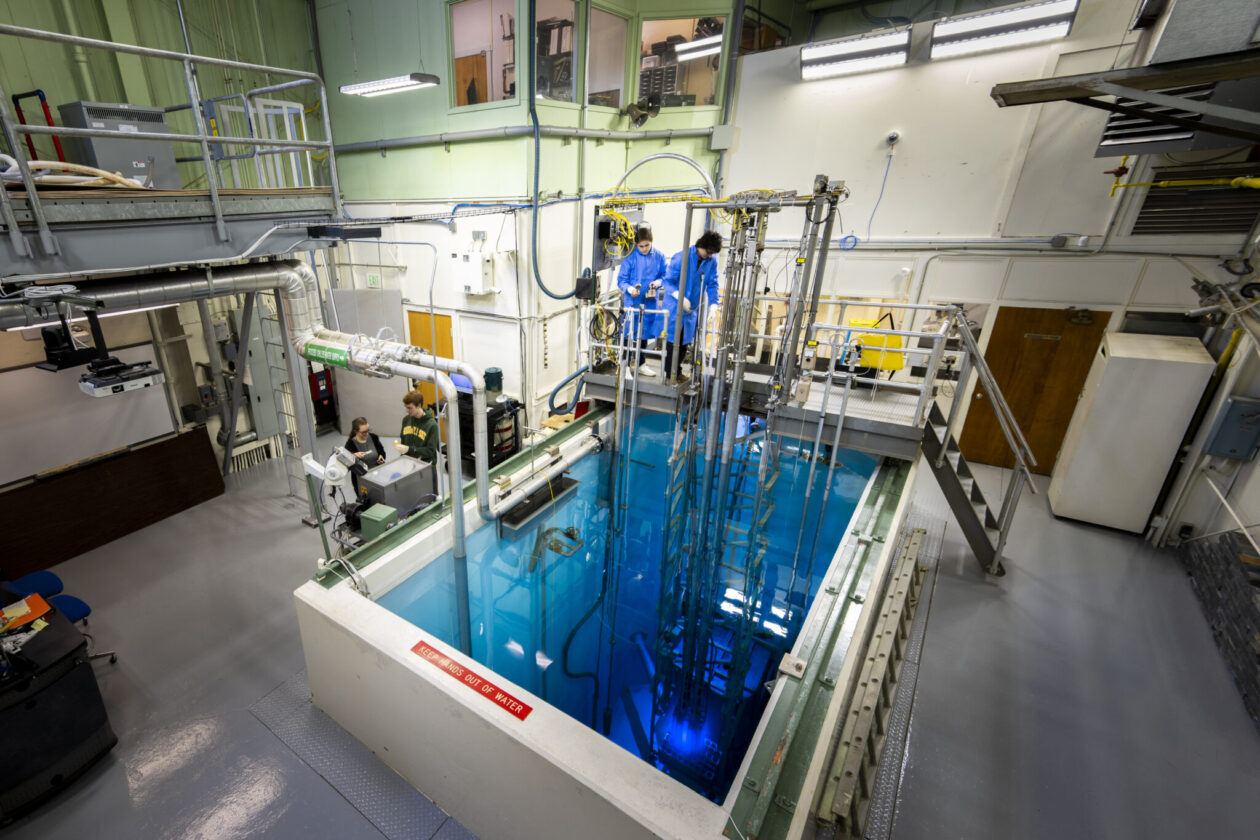
The Missouri S&T nuclear reactor glows blue with Cherenkov radiation from high-energy electrons moving faster than light in water. Photo by Michael Pierce/Missouri S&T.
A Missouri S&T researcher is partnering with Oak Ridge National Laboratory on a $1 million U.S. Department of Energy project to study how a nuclear fuel with a high enrichment level will perform in small modular and microreactors.
“Small modular and microreactors are being designed to operate for years in places where refueling isn’t practical, such as remote communities, military bases or even space missions,” says Dr. Ayodeji Alajo, an associate professor of nuclear engineering and radiation science at Missouri S&T.
“To do that, they need fuel enriched to a higher level than what today’s commercial reactors typically use. Our job is to show that this fuel will behave safely and predictably under different conditions so designers and regulators can trust it.”
The fuel is called high-assay low-enriched uranium, or HALEU. It contains between 5% and 20% uranium-235, placing it between the low-enriched fuel typically used in today’s commercial power plants and the highly enriched uranium once common in older research reactors.
The Missouri S&T Reactor, which Alajo will use for the study, operates on HALEU just under 20%. It is housed in a 32,000-gallon pool of water with a large graphite wall, allowing the S&T research team to test how the fuel behaves under different conditions when its neutrons are slowed to release energy.
“Operating the Missouri S&T Reactor shows the fuel works, but that’s not the same as creating benchmark-quality data that could then be transferable to the next-generation reactors,” Alajo says. “Think of it like someone driving a car every day, so youknow it runs. But until it’s tested under controlled conditions, you don’t have the full picture of its efficiency or performance. That’s the level of information new reactor designs require.”
Alajo says the goal is to have the information eventually included in international handbooks that serve as reference resources for licensing and safety analysis of nuclear systems.
The $1 million in funding comes through the DOE/Nuclear Regulatory Commission’s Collaboration for Criticality Safety Support for Commercial-Scale HALEU Fuel Cycles and Transportation.
To learn more about Missouri S&T’s nuclear engineering programs, visit nuclear.mst.edu.
About Missouri S&T
Missouri University of Science and Technology is a STEM-focused research university of over 7,000 students located in Rolla, Missouri. Part of the four-campus University of Missouri System, Missouri S&T offers over 100 degrees in 40 areas of study and is among the nation’s top public universities for salary impact, according to The Wall Street Journal. For more information about Missouri S&T, visit www.mst.edu.

Posted by Greg Edwards
 Sports Headlines
- Golf Starts Three-Day Tournament at Ken Partridge Invitational Tomorrow
- Baseball Extends Streak to 15; Three Miners Eclipse 100 Hits
- Edmonds and Sallade Record Milestones as Miners Win 7th Straight
- Volleyball Extends Streak to Six; Improves to 7-2 in GLVC
- Baseball Racks Up 25 Hits in Doubleheader Victory Over SBU; Win Streak Now at 14
Leave a Reply