Not your average summer camp: Teens operate nuclear reactor at Missouri S&T
Posted by Greg Edwards
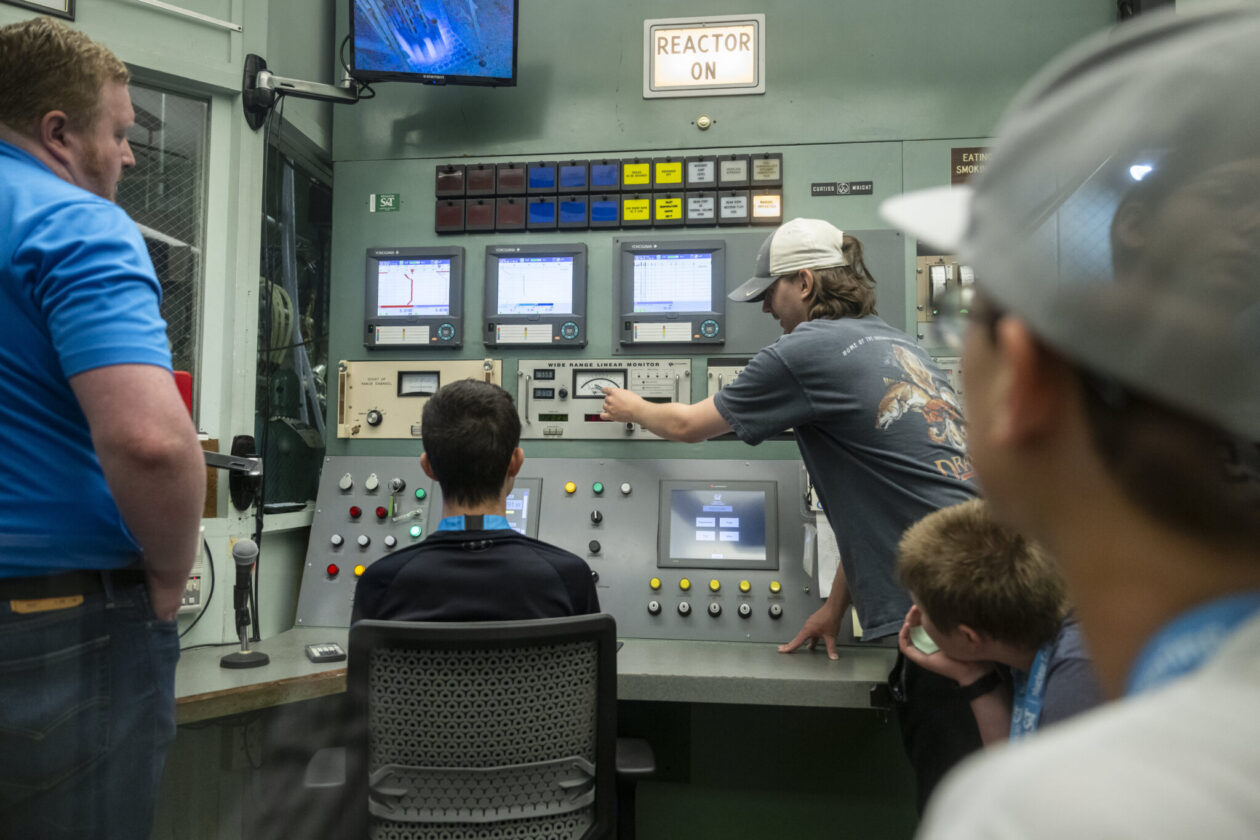
Participants control the Missouri S&T Nuclear Reactor during a previous session of S&T’s Nuclear Engineering Camp. Photo by Blaine Falkena/Missouri S&T.
Forty high school students from across the United States and abroad traveled to Missouri S&T and spent part of their summer doing something very few teenagers — or even adults — ever experience: operating a nuclear reactor.
“At Missouri S&T’s Nuclear Engineering Camp, we give students hands-on experiences that show them what nuclear engineering is all about,” says Dr. Joseph Newkirk, S&T’s chair of nuclear engineering and radiation science. “By actually working with our on-campus research reactor and exploring real-world applications, they can see how nuclear technology plays a role in everything from energy to medicine and learn more about what it means to be a nuclear engineering student.”
During the week-long camp, rising 11th- and 12th-grade students and recent high school graduates explore a range of nuclear topics, including power generation, nuclear materials, radiation detection, waste management, nuclear medicine, health physics, security, nuclear research and careers in the U.S. Navy. Several sessions are led by department alumni who now work in the nuclear industry.
This year’s campers cited everything from video games to HBO shows to YouTube video essays among their sources of inspiration for studying nuclear engineering. One camper’s path to S&T’s summer camp started due to her interest in rocks – especially the glowing variety.
“I like rocks and have a whole bunch in my garage,” says Raegan Davis, a rising senior from Slidell, Texas. “One day, my dad was like, ‘here’s a cool rock, and it glows.’ So then, I just started getting more and more glowing stuff.”
Davis’ growing collection of glowing rocks, glassware and earrings sparked her curiosity about what properties in the materials caused that effect. That interest eventually led her to explore nuclear science and make the trip from Texas to Rolla, Missouri, where she practiced operating the reactor.
She says her camp experience may have changed her plans for after high school.
“Before I came here, I was planning to go to another university, but now I am heavily considering Missouri S&T,” Davis says. “I came here and was allowed in the reactor, and I’m not even a student here. I am a high school student, and I got to go in and touch that stuff, and that’s really cool.”
Anu Bravo, a rising senior from Beecher, Illinois, compares the experience of learning to operate a nuclear reactor to a video game.
“It’s like the first stage of a video game when you’re learning the controls,” she says. “Then you gradually increase each step, adding more and more until you know all the controls in the game.”
Bravo says S&T’s Nuclear Engineering Camp gave her a clearer picture of what nuclear engineering involves and helped her figure out which areas of the field she most wants to study.
“This has been a good background to know if you’re interested in it, if you like it and what part of nuclear physics might interest you most,” she says.
Thomas Briard, a rising junior from Nassau, Bahamas, says he found out about Missouri S&T and Nuclear Engineering Camp thanks to ChatGPT, which he says gave high praise to the university’s offerings.
Briard says his curiosity for how the modern world works has fueled his passion for nuclear engineering.
“I’ve always been a kind of technical person,” he says. “I believe that everyone’s ultimate goal should be to truly understand how most of the modern world they live in works. I think it’s a travesty that so many people live their lives without understanding how the most complex and important parts of our civilization operate. And for me, at the core of that understanding is nuclear energy.”
Briard says hearing directly from current Missouri S&T students helped him better understand the day-to-day realities of the program and that alumni speakers added insights related to working in the nuclear industry.
“I think hearing from the counselors who are current students has been one of the most valuable parts of the camp for me,” he says. “It really helped me understand what I’d actually be doing and how I might fit in and provided me with a taste of college life.”
Dr. Ayodeji Alajo, an associate professor of nuclear engineering and radiation science at S&T, serves as the camp’s director. For more information about Missouri S&T’s summer camps, visit summer.mst.edu. To learn more about the university’s nuclear engineering degree programs, visit nuclear.mst.edu.
About Missouri S&T
Missouri University of Science and Technology (Missouri S&T) is a STEM-focused research university of over 7,000 students located in Rolla, Missouri. Part of the four-campus University of Missouri System, Missouri S&T offers over 100 degrees in 40 areas of study and is among the nation’s top public universities for salary impact, according to the Wall Street Journal. For more information about Missouri S&T, visit www.mst.edu.

Posted by Greg Edwards
Leave a Reply to Samantha Blake Cancel reply
 Sports Headlines
- Men's Golf Advances to GLVC Championship Match, Finish Runner-Up
- Miners Compete at Drake Relays; Knittel Competes Unattached Placing Fourth in Decathlon
- Miners Exchange Blows with Maryville in Series Opening Loss
- Miners Dominate Stroke Play, Advance as No. 1 Seed at GLVC Championships
- Baseball Update: Friday's Game 1 vs Maryville Moving to 1pm Start
This is absolutely astounding! Offering high school students hands-on access to a nuclear reactor for direct operation sounds like an incredibly rare and impactful learning experience the youth can take with them for years, possibly inspiring future careers in such a vital field.
It must be fascinating to see these young people engage with something so technologically advanced and typically considered exclusive. I’m especially curious how the Missouri S&T team simplifies the core physics involved so high schoolers can grasp the fundamentals clearly.
Also, for future camps, what kind of safety training or preliminary coursework do the students undergo to prepare them for managing tasks on a reactor? And are most involved teens driven by a passionate interest in nuclear science, or exploring it as a new realm of STEM?
An excellent summer camp & recruiting tool for future S& T students.