S&T students advance to Global Health Innovation Grand Challenge semi-finals
Posted by Kaitlin Brothers
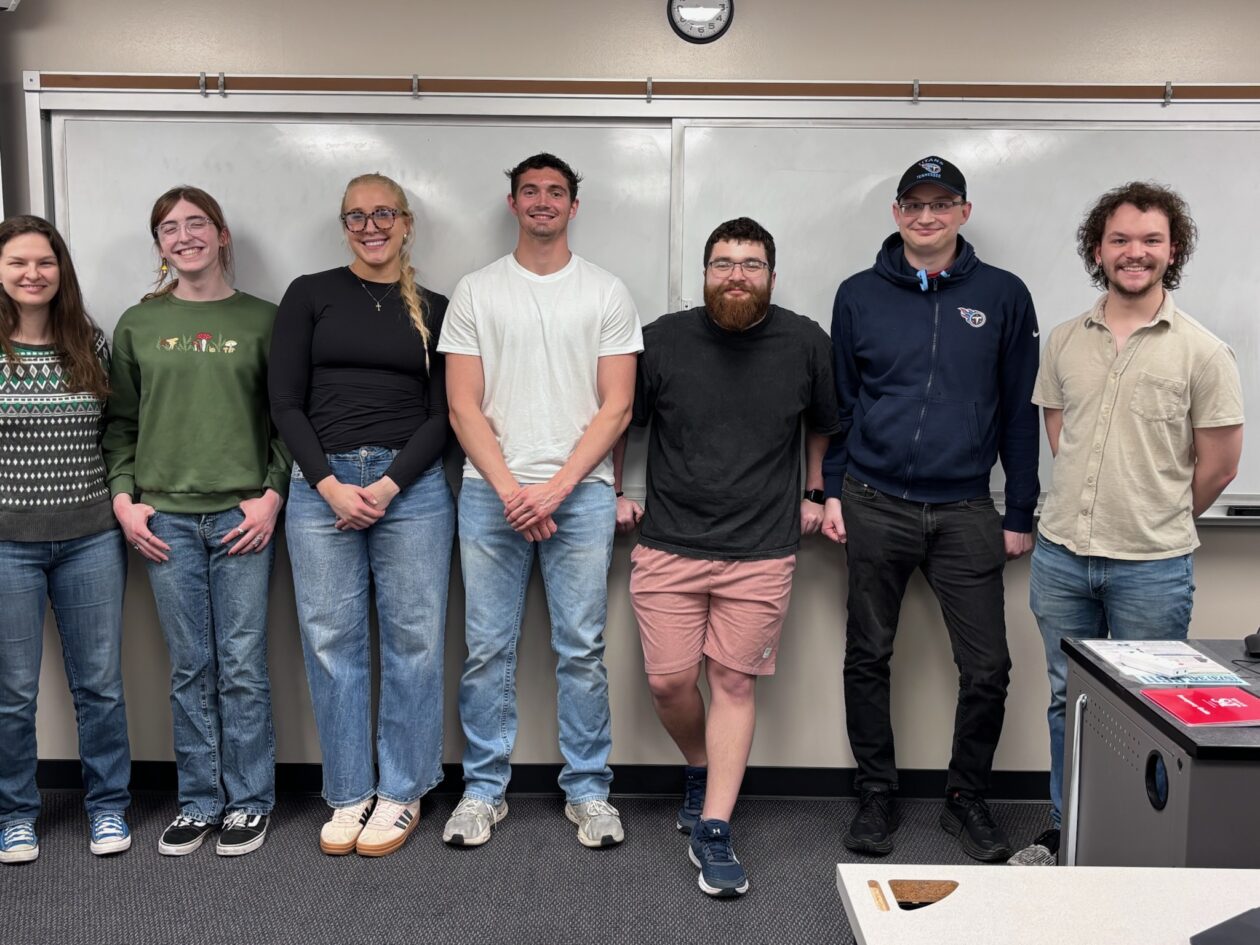
The three teams at Missouri S&T do “pitch practices” in the lead-up to the Global Health Innovation Grand Challenge semi-finals. From left: S&T students Meredith Long, Zoe Oakes, Anna Gilbertson, Justin Chadwell, Stephen Payne, Drake O’Leary and Connor Peterson. Photo submitted by Julie Semon.
Three teams of Missouri University of Science and Technology students and alumni have advanced to the semi-finals of the Global Health Innovation Grand Challenge hosted by the Carle Illinois College of Medicine.
The semi-final event will be held April 10-12 at the 2026 Global Summit in Taipei, Taiwan. The winning teams compete for funding to advance the development of their ideas into real-world clinical use. Each team is competing in different categories to solve problems that represent the most pressing global health challenges.
One team’s project is called Omniguard Patch, which is a bandage that would enhance natural healing processes while reducing the risk of infection. Students on this team are:
- Connor Peterson, a senior in biological sciences from Joplin, Missouri
- Stephen Payne, a senior in biomedical engineering from Higginsville, Missouri
- Drake O’Leary, a senior in biological sciences from O’Fallon, Illinois
- Parker Boyce, an S&T alumnus and third year medical student at University of Missouri–Kansas City from Hartsburg, Missouri
Another team’s project is called “FutureFlare,” an app that predicts intestinal flareups. Students on this team are:
- Tristan Crawford, a senior in biomedical engineering from Wappapello, Missouri
- Keith Miller, computer engineering graduate student from DeSoto, Missouri
- Justin Chadwell, a senior in engineering management from Norwood, Missouri
- Anna Gilbertson, a sophomore in biomedical engineering from Lake Zurich, Illinois
- Parker Boyce, an S&T alumnus and University of Missouri-Kansas City medical student from Hartsburg, Missouri
- Maya Washington, an S&T alumnus and third year medical student at University of Missouri–Kansas City from Saint Louis
The other team’s project is called “C-APP,” a new way to make personalized medical masks for infants. Students on this team are:
- Zoe Oakes, a junior in computer science and psychology from O’Fallen, Missouri
- Meredith Long, a senior in biological sciences and computer science from Jefferson City, Missouri
- Ryan Riedy, a junior in mechanical engineering from Barnhart, Missouri
- Braylie Murrey, a sophomore in biological sciences major from Wichita, Kansas
- Adrian Peacock, an S&T alumnus and third year medical student at University of Missouri School of Medicine from St. Charles, Missouri
“Truly transformative solutions in global health emerge when different disciplines come together, and these teams exemplify the power of collaboration between engineering, science and medicine,” says Dr. Julie Semon, associate professor of biological sciences. “We have students from all three colleges, as well as our alumni at UMKC and Mizzou’s medical schools. This opportunity reflects S&T’s commitment to preparing students not only to excel academically but also to apply their knowledge to global challenges.”
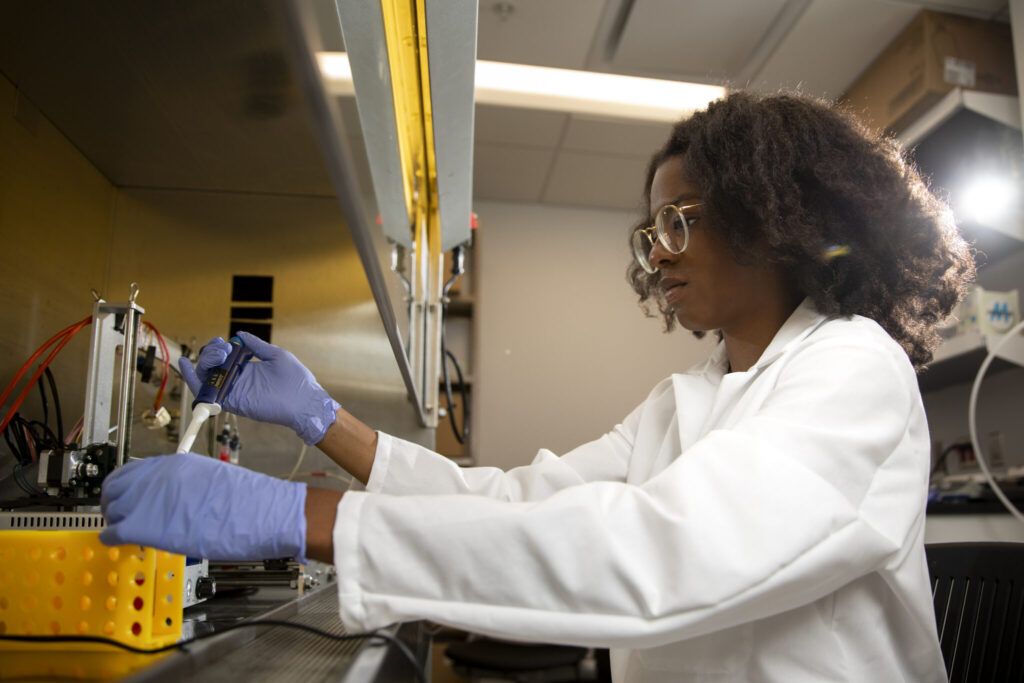
Semon says participating in this competition allows these students to showcase their creativity, engage with innovators from around the world and take meaningful steps toward becoming the next generation of leaders in health innovation.
“Beyond their impressive work, these students are a joy to mentor and collaborate with, bringing enthusiasm, curiosity and positivity to every stage of the process,” Semon says.
The C-APP project aims to print C-PAP masks for babies in hospitals. The masks will be customized to fit each baby’s face to prevent pinching and air leaks. Meredith Long, a member of the C-APP team, says the challenge is an opportunity to advance their project through medical testing and trials.
“Having that money behind us would really be able to get this into the hands of the people who need it faster,” Long says. “This is a wonderful project, and everyone who joined our team is really passionate about it.”
C-APP team member Zoe Oakes says clinical trials would be a big hurdle for them, especially since the printer for the masks is about $9,000.
“The funding would accelerate the whole process,” Oakes says. “And it’s a great opportunity. I’ve never traveled to Asia before, so I’m excited.”
Justin Chadwell, a member of the FutureFlare team, says he got involved in the Global Health Challenge to apply the skills he has learned at S&T so far. The team’s project aims to help people with Inflammatory Bowel Disease (IBD) by using AI and programming to develop software that can predict flareups before they happen.
“People with IBD suffer on a consistent basis, and the foundation of what we are making is to ease their suffering with developing technologies,” Chadwell says. “This project is important because of the steps it can take in the right direction, tying in where technologies are developing to pain points that people experience in everyday life.”
Anna Gilbertson, also a FutureFlare team member, says this challenge offered a great opportunity for their company to gain exposure at an international level.
“We are looking for opportunities to expand our technology beyond IBD and into other areas of medicine. Beyond the prize money from the competition, we are hoping to gain networking exposure,” Gilbertson says.
Connor Peterson, a member of the Omniguard Patch team, says he got involved in the challenge through Dr. Semon’s Biodesign and Innovation course.
“She encouraged us to pitch our product at the S&T Startup Challenge. We made it to finals, but we didn’t end up placing. We were pretty discouraged about our loss, but she told us to keep our heads up and sent us the information about the Global Health Innovation Grand Challenge. It was clear that she believed in us.”
Peterson says the project could provide an opportunity for the team to represent S&T on a wide scale.
“This project gives us a chance to represent S&T internationally, and show professionals in the biomedical engineering industry that we are a university that prioritizes innovation,” he says.
Peterson says ideally, their team would make it to finals to invest money into the project.
“I cannot overemphasize how grateful I am for the support of Dr. Semon,” Peterson says. “She has pushed us to realize just how much potential we have.”

Posted by Kaitlin Brothers
 Sports Headlines
- Smith Hits 7 RBIs in Victory over Rockhurst that Sets Program Record for Consecutive Wins with 11
- Softball Rallies Back, Secures Game Two Victory Over UIS
- Golf Set for Belterra Invite; Seeking Sixth Straight Top-3 Finish
- Miners Take Down Bearcats in Three, Extend Streak to 13 Straight Sets Won
- Baseball Picks Up Doubleheader Sweep Over Rockhurst, Ties Two Program Records
Leave a Reply